
Your AI is working. So why is volume up?
Lowering the cost of asking changes customer behavior—and your economics.
If your AI rollout is “working,” your volume graph may already be bending upward.
AI is delivering on the headline promise: lower cost per contact. But a senior CX exec at a global tech company said something last week that reframed it for me:
“If you make it effortless to ask, you shouldn’t be surprised when people ask more.”
That’s not a side effect. It’s the new reality.
When support starts to feel like a search bar—instant, low-friction, always there—you don’t just handle the same customers faster. You activate customers who used to stay silent because the effort wasn’t worth it.
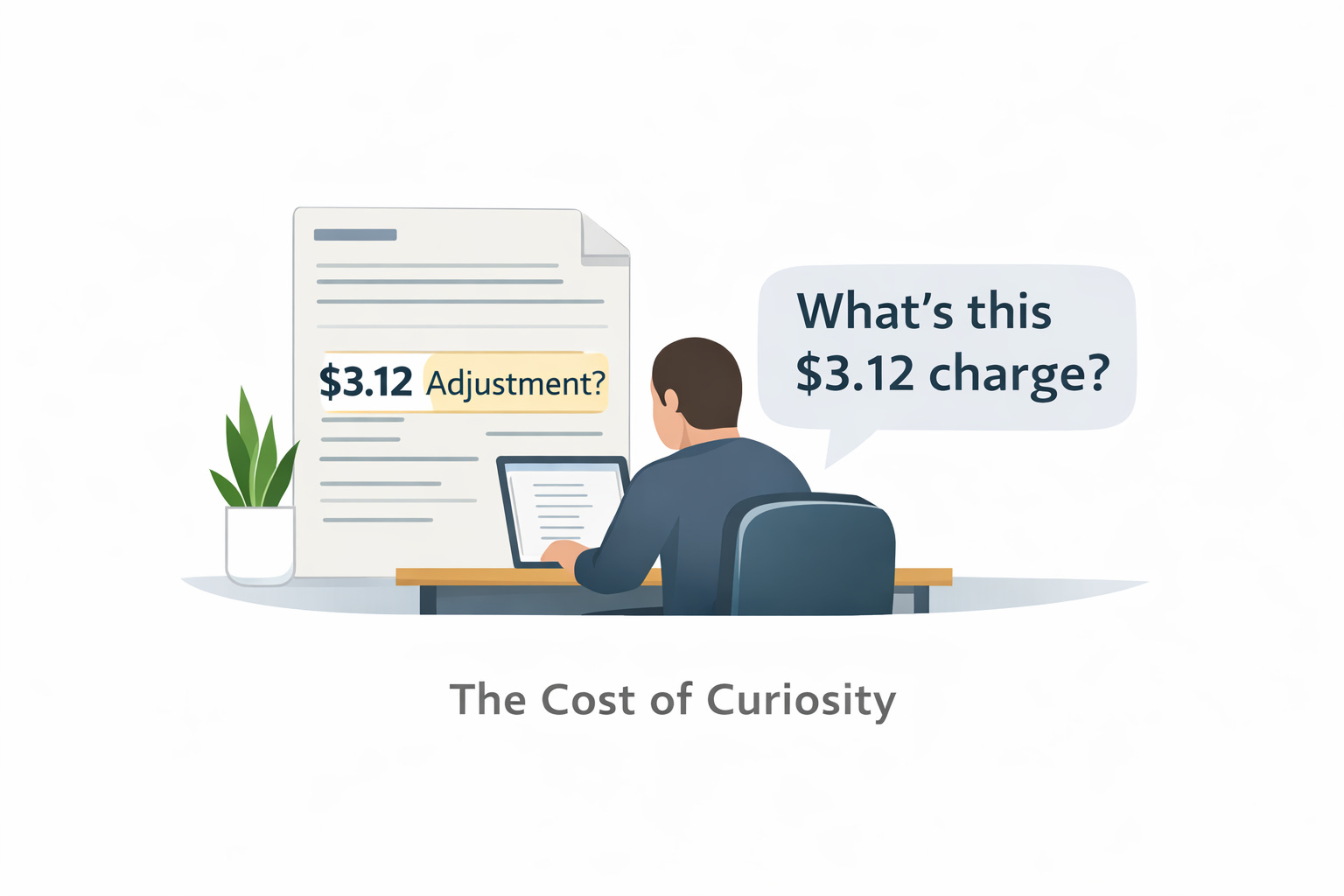
She called it the Cost of Curiosity: when curiosity becomes cheap, demand expands.
A tiny example makes the point.
Before AI, a customer might stare at a slightly confusing invoice, shrug, and move on. After AI, they open chat and ask, “What’s this $3.12 adjustment on line 4?” That’s a good question. It’s also a question that probably never would’ve become a ticket in the old world.
So the shape of demand changes.
Why this matters (beyond the obvious)
Most teams track AI impact as a productivity story: deflection up, cost down.
But what often changes first is customer behavior:
They ask earlier in the journey (before a problem becomes a complaint)
They ask smaller questions (that never would’ve become a ticket)
They test the edges (because “what if…” is now easy)
Each interaction is cheap.
The system may still get more expensive if volume, retries, and escalations rise.
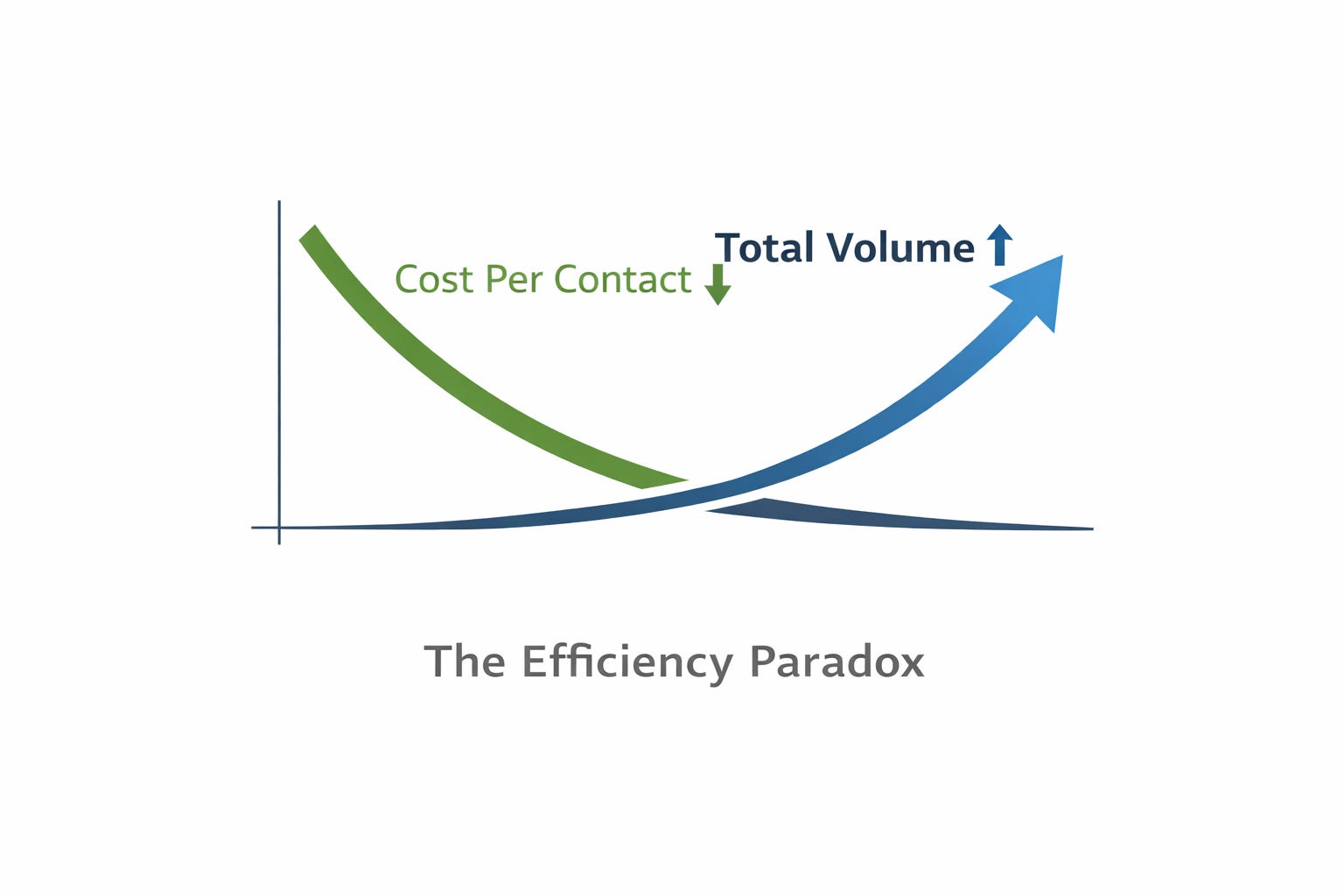
That’s the efficiency paradox: unit cost falls while total workload grows.
A simple mental model: friction used to be a heavy gate. When it’s hard to push open, fewer people try. When AI makes the gate swing freely, more customers walk through—some with real issues, some with questions they’d never have bothered asking before.
A quick way to tell if rising volume is “good” or “bad”
Not all extra contacts are a problem. Some are a signal that your experience is approachable.
The question isn’t “did volume increase?”
It’s “what kind of volume increased?”
Here are three patterns I look for:
1) Healthy expansion (good volume)
You see more questions, but fewer repeat contacts. Customers get answers and move on.
Signal: first-contact resolution improves, and follow-up within 7 days declines.
2) Thin-answer inflation (bad volume)
The bot answers quickly but shallowly, so customers come back, rephrase, or escalate.
Signal: retries and channel-hopping increase even if CSAT looks “fine” on the first chat.
3) Shifted effort (hidden volume)
AI “deflects,” but customers pay the effort tax elsewhere—agent queues, email follow-ups, social, product returns.
Signal: call drivers change slowly, but backlogs and time-to-resolution creep up.
If you had to explain rising volume to your CFO tomorrow, could you clearly separate:
That’s the diagnosis.
What to do next: measure contact elasticity, not just cost per contact
If cost per contact is your only headline metric, you’ll miss the demand curve you just reshaped.
Start tracking contact elasticity: how much total demand changes when you lower friction.
A practical measurement set most teams can implement:
A) Incremental volume rate
Of all AI conversations, how many are “new demand” vs. replacing a prior channel?
How to estimate: track whether a customer had a contact in the last 7–14 days, and whether the issue category matches.
B) Containment with resolution
Not just “contained.” Contained and done.
Add a simple follow-up check: “Did this fully solve it today?” + verify with repeat-contact rate.
C) Retry rate (the canary metric)
How often do customers ask again within the same session or return within 24–48 hours for the same topic?
If this climbs, you’re manufacturing volume.
D) Escalation quality
When handoff happens, is it cleaner or messier?
Measure: agent handle time for AI-escalated cases vs. non-AI cases, and % of escalations that require customers to restate the issue.
Four moves that usually reduce “bad volume” fast
If you want volume to rise without dragging costs back up, these levers are reliable:
1) Treat AI like a resolver, not a router
Don’t optimize for “end chat.” Optimize for “finish the job.”
Give it permission to do the next step (reset, refund, status change) where policy allows.
2) Build an escalation that feels like progress
Escalation isn’t failure. It’s part of the experience.
Make the bot summarize what it learned, confirm details, and pass a clean case file to the agent.
3) Instrument uncertainty (and redesign around it)
Where the model is least confident is where retries come from.
Log low-confidence intents, missing data fields, and “answer rejected” moments—then fix the flows, not the prompts.
4) Use curiosity as product feedback
The “small questions” are gold. They point to confusing UI, unclear policy, missing onboarding, and broken expectations.
Route top curiosity drivers to Product weekly. It’s one of the fastest ways to reduce future demand.
The bottom line
AI doesn’t just automate support. It changes what customers decide is worth asking.
Your advantage isn’t “deflect more.”
It’s resolve more—with fewer retries, fewer escalations, and cleaner handoffs.
So, I’ll leave you wth this question to explore:
What percentage of your AI interactions truly end the problem — not just the conversation?
www.marklevy.co
Follow me on Linkedin
What Successful CX Leaders Do on Sundays
DCX Links: Six must-read picks to fuel your leadership journey delivered every Sunday morning. Dive into the latest edition now!
Thanks for being here. I’ll see you next Tuesday at 8:15 am ET.
👉 If you enjoyed this newsletter and value this work, please consider forwarding it to your friends and colleagues or sharing it on social media. New to DCX? Sign Up.
✉️ Join 1,500+ CX leaders who stay ahead of the next customer curve.
Human-centered insights. Plug-and-play frameworks. Smart tools that actually work.
All designed for CX pros who want to build with purpose—and deliver with impact.
👉 Subscribe today and get the tools to elevate your strategy (and your sanity).


