

AI shopping is about to create a very human problem
Plus: The tech can act faster. Customers still need clarity, control, and a way out when it gets the call wrong


Your daily signal on AI and CX — minus the hype.
📌 DCX Stat of the day: Radial found that 58% of consumers are open to ordering through an AI assistant, yet only 6% have actually done so. It also found that 19% would never trust AI with payment information.
In this issue:
→ Target pushes AI shopping risk onto customers
→ Shopping agents create a new consent problem
→ Trust still decides the sale
→ Fullstory finds the friction faster
→ Payments are getting ready for agents
CONTEXT
Retailers are getting the legal cover in place early
Target’s updated terms now include “Agentic Commerce and Delegated Access.” If a customer authorizes an approved AI agent, that agent can sign in, change carts, place orders, and start returns. Target says those actions count as authorized by the customer, and it does not guarantee the agent will behave as intended.
That matters because it tells you where retail is headed. AI shopping is moving past product discovery. It is getting closer to execution. And once software starts acting for the customer, the cost of a mistake moves from annoyance to operations.
WHY IT MATTERS
The industry has spent a year talking about AI recommendations. Fine. That was the easy part.
The harder question is what happens when AI picks the item, places the order, and triggers the return. Walmart has already pointed to agent-led commerce as an emerging shift. OpenAI just expanded shopping in ChatGPT with richer product discovery and comparison tools. The direction is clear. AI is moving from helping customers browse to acting on their behalf.
That changes the CX brief. The issue is no longer whether the recommendation engine is clever. The issue is whether the journey can survive a wrong decision made fast.
EXEC SUMMARY
🎯 Exec Briefing: Why this should be on your agenda
Consumer AI is moving into the expensive part of the journey.
A bad recommendation wastes a few seconds. A bad purchase creates returns, contacts, disputes, refund cost, and lost trust. That is not a product problem. That is a business problem.
CX leaders now need AI-assisted actions to be clear before payment, easy to review, and easy to reverse. If that sounds basic, good. Basic is where most digital journeys still break.
📬 Copy-Paste Take: Send this to your COO
AI shopping is getting closer to checkout, but customer trust is nowhere near the same pace. If AI can add, buy, or return, then consent, review, cancellation, and dispute handling become core CX controls. Suggested action: audit every AI-assisted purchase flow now, before volume turns a design gap into a service problem.
🔎 Deep dive
Delegated shopping changes the CX job
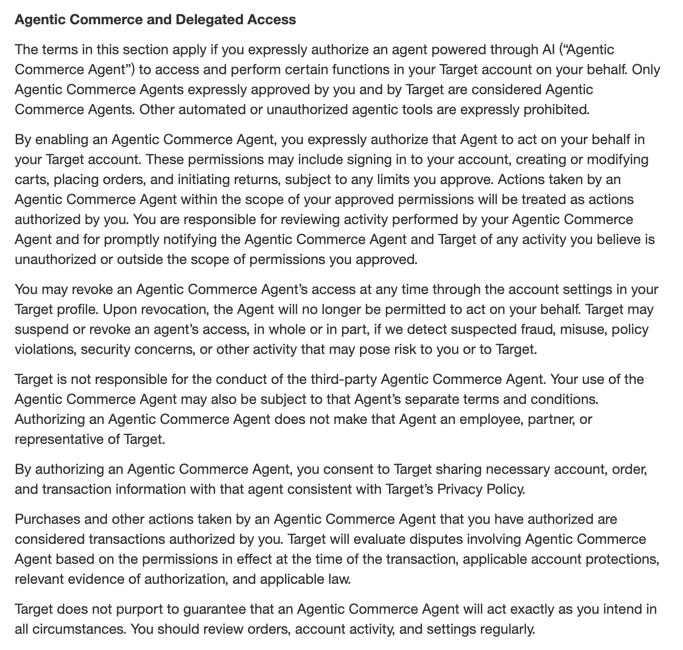
The important shift is not that AI can recommend products better. It is that retailers are preparing for AI to act on the customer’s behalf.
That is why Target Terms & Conditions matter. The company now spells out what happens when an approved AI agent signs in, modifies a cart, places an order, or starts a return. Once that activity is treated as customer-authorized, the CX problem changes. It moves from discovery quality to consent, review, reversal, and recovery.
A lot of teams are still focused on prompts and product pages. The harder work sits downstream in permissions, order review, returns logic, and dispute handling.
That is the operating signal here. AI can reduce effort at the front of the journey while increasing the cost of mistakes at the back.
OPERATOR PLAYBOOK
Pressure-test delegated checkout before it scales
Start with one workflow: AI-assisted cart creation through order confirmation.
Audit every delegated shopping flow for four things:
Clear approval before any order is placed
A visible summary of item, price, seller, and delivery terms
Easy edit and cancel paths before fulfillment locks
Fast recovery when the AI gets the intent wrong
Then test whether support can see the full chain: what the customer asked for, what the AI changed, and what was finally approved.
Ask your team: If a customer says, “the bot bought the wrong thing,” can we prove intent and fix it in one contact?
Signal: In delegated commerce, reversibility is part of conversion.
📈 Market Reality Check
AI can narrow the list. Trust still closes the sale.

ChannelEngine’s 2026 research makes the gap obvious. AI already influences shopping behavior, but checkout still runs on trust signals. 58% of shoppers have used AI to research products. 37% have started a purchase journey through an AI assistant. Only 17% are comfortable buying directly through AI.
The implication is not subtle. AI may drive more shoppers into the funnel, but it will not rescue weak product data, muddy seller clarity, fragile fulfillment, or painful returns. Teams that treat AI as a shiny new acquisition surface without fixing those basics will create more doubt and more service demand.
AI discovery + weak trust signals = higher assisted service cost
🧰 Tool Worth Knowing
Fullstory StoryAI
What it does: Fullstory StoryAI uses behavioral data to generate session summaries, surface opportunities such as funnel drop-offs and spiking issues, and answer questions inside dashboards, segments, and session replay. Fullstory says StoryAI Premium adds proactive opportunities and Ask StoryAI. The system is powered by Google Gemini and can be opted out by admins.
CX use case: Use it to spot the friction that matters before AI shopping amplifies it. If shoppers hit confusing product pages, seller ambiguity, or broken handoffs, this kind of tool can find the pattern faster than manual replay review.
Worth watching because: The value is speed. Not because summaries are exciting. Because faster prioritization matters when small bits of friction start creating returns, contacts, and abandoned baskets.
Bottom line: Good fit for teams that need faster visibility into digital friction. No public performance metrics shared, so treat the upside as workflow compression until proven in your environment.
⚡ 90-Second CX Radar
Mastercard expands live agentic payments across Latin America
Mastercard says live end-to-end agentic payment transactions were completed across the region with full cardholder consent, using Agent Pay, agentic tokens, passkeys, and a trust layer it calls Verifiable Intent. Payments infrastructure is preparing for agents quickly. Most CX models are not.
OpenAI just made shopping in ChatGPT richer and more visual
OpenAI’s latest shopping update improves browse, compare, and refine behavior inside ChatGPT. That puts pressure on brands to make product data machine-readable and customer-trustworthy. Those are not the same thing, and most teams are weak at both.
🧭 Your Move
Pick one high-intent consumer journey this week and review it as if AI, not the customer, is driving. Where does consent happen? Where can the order be reviewed? Where can it be stopped? Where does support recover the mistake?
That exercise will tell you fast whether the journey is actually ready for delegated commerce, or just dressed for it.
Convenience loses its charm when the return starts.
Until tomorrow,

👥 Share This Issue
Think of one person who’s wrestling with AI in CX right now and forward this to them.
I’m obsessed with Wispr Flow Pro! Get a Free Month on me.
