

Customers Are Hiring Backup
DCX Links July 12, 2026

Welcome to the DCX weekly roundup of customer experience insights!
Most companies still treat customer effort as a UX problem: a few too many clicks, a clumsy page, a long hold time.
But some of the worst effort lives elsewhere. It’s the work customers take on because the company won’t carry it: scanning their own groceries, chasing an airline claim, babysitting a handoff, or keeping track of a basic task that should’ve just happened.
That’s the thread running through this week’s links. Customers are finding backup for jobs companies quietly handed them, from a staffed checkout lane to software that chases a claim.
Automation can help. But it only earns its place when it takes work off the customer. When it merely moves work around, people notice.
This Week’s Must-Read Links
Walmart’s self-checkout retreat is really about customer loyalty

Self-checkout had a clean pitch: shorter lines, lower labor costs, more control for shoppers. Then customers got stuck weighing produce, waiting for an override, packing bags under a camera, and wondering why a quick grocery run suddenly came with a shift assignment.
What’s happening: Vance Morris argues that Walmart, Target, and Dollar General aren’t just dialing back self-checkout because of shrink. They’re responding to the experience cost of making customers do work the store used to do. That cost shows up in irritation, distrust, and the simple decision to shop somewhere else when the errand feels harder than it needs to.
Why it matters: This is where automation conversations get slippery. A company can remove a staffed lane and call it convenience. The customer judges the whole exchange: Did it save time? Did it make me feel competent? Was help there when the machine balked? Did the store make me do its work?
Reality check: Self-service is a trade, not a free upgrade. Customers will make it when the payoff is obvious. They won’t keep making it when the store pockets the benefit and leaves them with the hassle.
Worth asking this week: Where have we called something self-service when customers would call it unpaid work?
The first all-robot hotel is a hospitality stress test

A fully robot-staffed hotel is coming to the artificial island built for China’s Shenzhen-Zhongshan Link. The easy headline is novelty. The more useful one is that hospitality is about to find out which parts of a stay are really transactional and which parts depend on somebody noticing.
What’s happening: New Atlas reports that the hotel, planned for 2027, will put robots to work across reception, cleaning, and other guest-facing jobs. That’s a big enough experiment to be interesting even if it ends up feeling more like a demo than a destination.
Why it matters: A guest doesn’t need much human contact when everything goes right. The need shows up when the room isn’t ready, the directions are wrong, a child is sick, or a late arrival needs a decision that isn’t in the script. Hospitality has always depended on these unscripted moments, even when the operating model barely acknowledges them.
Between the lines: Judge this hotel by recovery. Delivering a towel is easy; getting a stranded guest back on track is where hospitality earns its keep.
Worth asking this week: In our most routine journeys, where does a human still carry the judgment customers rely on?
A household run by AI agents shows where delegation starts

Jesse Genet has put AI agents to work on the kind of life admin most people keep in their own heads: parenting logistics, homeschooling, reminders, follow-ups, and all the loose ends that make a week feel like a pile of tabs left open.
What’s happening: The Cut profiles Genet’s growing team of agents and the way they handle pieces of family coordination. It’s an unusual setup, sure, but the need behind it isn’t unusual at all. People are tired of being the manual link between every service, appointment, purchase, and promise in their lives.
Why it matters: Many customer journeys still assume the customer will remember every deadline, compare every option, chase every exception, and bring all the context back when something breaks. That assumption gets expensive once a person has someone, or something, handling the admin for them.
The bottom line: A delegated customer journey has two audiences. The customer still wants confidence and control. The agent needs clean information, proof it can rely on, and a next step it can actually complete.
Worth asking this week: Which parts of our experience are only tolerable because customers are still doing all the coordination themselves?
AirKaren is what happens when service recovery becomes customer work

AirKaren is funny until you sit with why it exists. Nobody wants to become an amateur airline lawyer after a disrupted flight. They do it because getting a fair answer can mean reading regulations, assembling evidence, filing a claim, and following up until somebody finally responds.
What’s happening: AirKaren says it will take on that job for travelers. A customer explains what went wrong, then the service cites the relevant rule, files the claim, and pursues the compensation or remedy the traveler is due.
Why it matters: This is customer effort in its least flattering form. The service failure has already happened, yet the customer still has to learn the company’s rulebook before the company will make things right. The recovery model is broken long before anyone complains about the interface.
Reality check: An outside advocate becomes attractive when a brand makes its own customers prove they deserve help. By that point, the airline may settle the claim, but it has given up the relationship.
Worth asking this week: After a service failure, how much procedural work does a customer have to do before they get a fair answer?
DCX Stat of the Week
One-third of customers are ready to delegate the decision
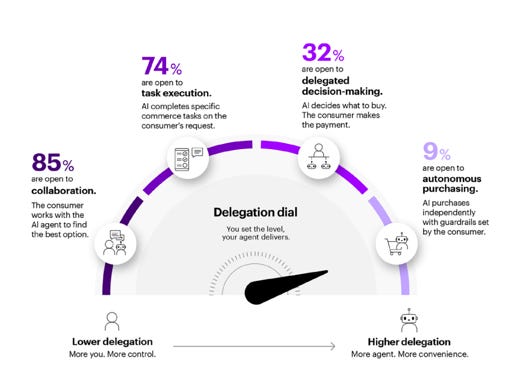
32% of consumers would allow an AI agent to make purchase decisions within boundaries such as budget and preferences, with the customer approving the final purchase.
Takeaway: The agent may soon narrow the field before the customer sees the options. Being available at checkout will not matter if the brand never makes the shortlist.
Use this in a meeting: We need to know what an agent can prove about us before a customer ever lands on our site.
Source: Accenture Consumer Pulse Research 2026
CX Signal of the Week
Will Guidara on the Restaurant Mistake Customers Feel
“Most restaurants get this wrong,” says Will Guidara in this EntreLeadership clip. His point: teams make decisions from their side of the counter, then mistake an operationally sensible process for a good guest experience.
It sounds obvious until a team is standing inside its own process. Short staffing, a backed-up kitchen, an old policy, and a clumsy handoff can all look reasonable from the inside. Across the dining room, the guest is simply waiting, guessing, or trying to work out whom to ask.
Why it matters: Restaurants make the lesson easy to see, but the problem travels. Customers don’t experience your org chart, your staffing model, or the exception that made sense in last Tuesday’s meeting. They experience the moment in front of them.
Lesson for CX Pros: Get out of the internal story and watch the actual moment. Better yet, make the owner of the journey walk it with you. The conversation changes fast when the rough edge isn’t a slide, but something happening in real time.
Use this in a meeting: When did we last experience this journey exactly as a customer would, with no internal shortcuts?
Have a CX signal to share? Reply and let me know!
One Last Thing
Customers are not waiting for companies to make every experience easier.
They are finding ways around the work.
They are rejecting self-service that feels like labor, testing what robots can take over, assigning admin to agents, and using outside tools to fight for recovery. That does not mean every company needs more automation.
It means every company needs a clearer view of the work it has pushed onto customers.
Start there.
Have a great week ahead!

If this edition sparked ideas, share it with a colleague or team member. Let’s grow the DCX community together!
✉️ Join 1,500+ CX leaders who are done feeling like they’re pushing change uphill alone.
Every week, you get human-centered insights, plug-and-play CX frameworks, and AI tools that actually work inside real organizations — so you’re not guessing your way through the next “customer-first” initiative.
Human-centered, commercially-aware, and honest about what it really takes to move the customer curve.
👉 Subscribe today to give yourself one steady, reliable source of support for your strategy — and your sanity.