

OpenAI just Clarified Where AI Competition is Heading
Plus: Google moves voice AI closer to scaled use


Your daily signal on AI and CX — minus the hype.
📌 DCX Stat of the day: Gartner says more than 50% of customer service organizations will double their technology spend by 2028. That is a meaningful signal, but not necessarily a positive one. Higher spend does not guarantee better journeys.
In this issue:
→ OpenAI signals the end of fragmented AI experiences.
→ Google pushes voice AI closer to production reality.
→ Regulators raise pressure on call-center transparency.
→ A hidden breach exposes visible customer friction.
→ Unwrap helps teams catch feedback signals earlier.
CONTEXT
OpenAI is moving beyond separate AI products toward one operating layer
OpenAI says it is building a unified AI superapp because users do not want disconnected tools. That is a notable shift in framing. It suggests the market is moving away from isolated AI experiences and toward systems that can carry context across tasks, channels, and workflows.
For CX leaders, that matters because fragmented AI is no longer just a technology architecture issue. It is increasingly a customer effort issue. When search, chat, self-service, agent assist, and workflow tools operate independently, the result is often repetition, weak handoffs, and avoidable friction. Reuters also reported OpenAI is narrowing focus and consolidating around integrated, user-centered tools, which gives this move broader strategic weight.
WHY IT MATTERS
The important shift here is not feature breadth. It is control of continuity. The vendor or platform that can preserve customer context across moments will be in a stronger position than the one that simply automates each step separately.
That has direct CX implications. The first visible impact will not be in abstract AI strategy. It will show up in routine moments: a customer who starts in self-service, moves to chat, lands in voice, and expects the company to know what has already happened. If your operating model cannot support that, AI will amplify fragmentation rather than reduce effort.
EXEC SUMMARY
🎯 Exec Briefing: Why this should be on your agenda
OpenAI’s superapp move matters because it reframes the competitive question. This is becoming less about isolated AI capabilities and more about who can maintain context across the customer journey.
That puts pressure on orchestration, identity, and QA. If those remain siloed across teams and platforms, the break will appear first in repeat contact, transfer rates, containment performance, and trust.
📬 Copy-Paste Take:
The next AI advantage in CX will not come from automating channels separately. It will come from preserving customer context across the full journey.
🔎 Deep dive
The real strategic issue is not the bot. It is the handoff.
Many teams will interpret OpenAI’s move as a packaging story. That misses the larger point. The market appears to be shifting toward one operating layer that can carry intent across tools, channels, and tasks.
For CX leaders, that changes the center of gravity. The main question is no longer which assistant is smartest in isolation. It is whether the system can preserve customer history, identity, and intent as the journey moves from one moment to the next.
That is also where the risk sits. If new AI capabilities are layered onto weak handoff design, the likely outcome is not a better experience. It is a faster version of the same fragmentation.
OPERATOR PLAYBOOK
Assess continuity before adding more AI to the journey
Choose one high-friction journey this week. Returns, billing disputes, onboarding, or password recovery are good candidates. Then map where context is lost.
Audit every cross-channel support flow for four things:
Whether customer intent carries from self-service into assisted support
Whether identity is reused safely instead of being restarted unnecessarily
Whether the agent can see prior customer actions, not just the final case summary
Whether there is a workable fallback when the AI stalls, misfires, or reaches a limit
Then test whether the AI path is reducing effort or simply deferring it until escalation.
Ask your team: Where does the customer need to repeat themselves today, and what would it take to remove that point of friction?
Signal: AI maturity in CX will increasingly depend on continuity, not just automation.
📈 Market Reality Check
Budget growth is coming. Discipline will matter more.

Gartner says more than half of customer service organizations will double their technology spend without an equivalent reduction in talent by 2028. That is an important investment signal. It does not, however, guarantee that service outcomes will improve at the same rate.
The risk is straightforward. Companies may expand AI spend without meaningfully redesigning the journey. In that case, they will add more software around the experience without reducing friction inside it.
Higher spend + weak handoffs = more expensive friction.
🧰 Tool Worth Knowing
Unwrap
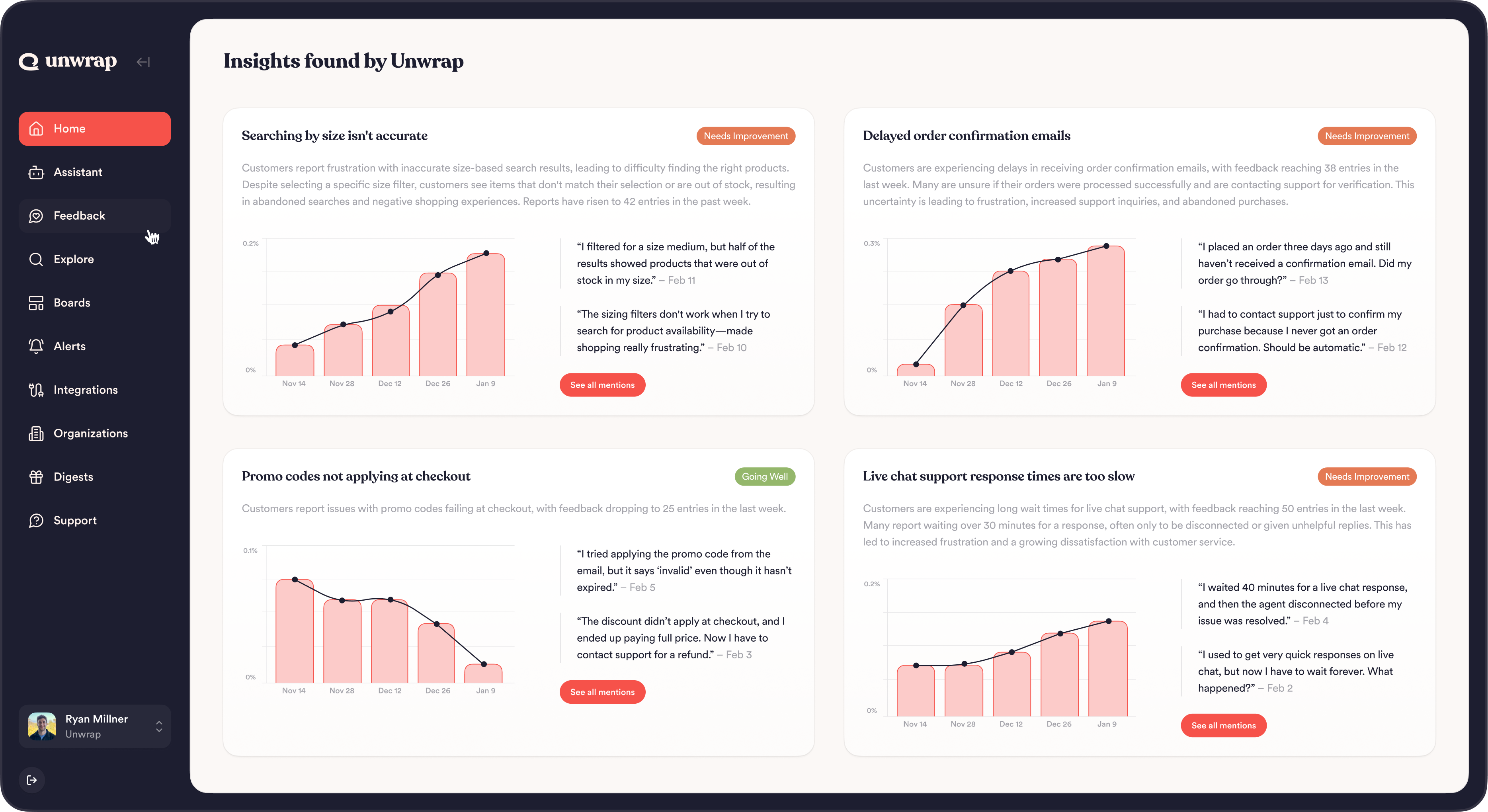
What it does: Unwrap is a customer intelligence platform designed to make unstructured feedback easier to analyze. It auto-categorizes signals, surfaces emerging trends, supports natural-language analysis, and includes PII redaction controls.
CX use case: Useful when support, product, and digital teams are all hearing similar issues but lack a shared view of what matters most.
Worth watching because: The practical value is not in sentiment as a headline metric. It is in earlier issue detection, better cross-functional visibility, and faster prioritization when customer friction starts to build. The caveat is that most proof points on the site come from customer stories and vendor framing, so independent outcome validation is still limited.
Bottom line: A credible option for teams with plenty of feedback and too little operational clarity.
⚡ 90-Second CX Radar
Google’s latest voice model moves automation closer to scaled use
Google says Gemini 3.1 Flash Live is its strongest audio model yet and has already rolled out broadly. That matters because voice AI is approaching the quality threshold where deployment decisions become operational, not experimental. The QA burden will rise with it.
Anthropic’s Australia deal is another sign governance is becoming part of the operating model
Anthropic’s agreement with Australia points to closer scrutiny around safety, capability, and economic impact. For enterprise teams, this is a reminder that governance is moving closer to deployment, measurement, and reporting.
A supply-chain breach hits software customers rarely think about until it fails
Reuters reported malicious code was inserted into an Axios update, creating potential exposure of login credentials. This is the kind of infrastructure issue that quickly turns into a CX issue through authentication trouble, account recovery pain, and trust erosion.
🧭 Your Move
This week, do not focus only on which AI capabilities you can add. Focus on where customer context gets lost today. That is where the next wave of CX advantage, or failure, will become visible first.
In the next phase of AI in CX, continuity will matter as much as intelligence.
Until tomorrow,

👥 Share This Issue
Think of one person who’s wrestling with AI in CX right now and forward this to them.
I’m obsessed with Wispr Flow Pro! Get a Free Month on me.
