
The CX Stack Is Eating the Org Chart
The old stack routed customer work around the company. The new one decides who does the work, whose judgment wins, and who gets blamed when the machine acts.
The easy take is that the CX stack is getting smarter.
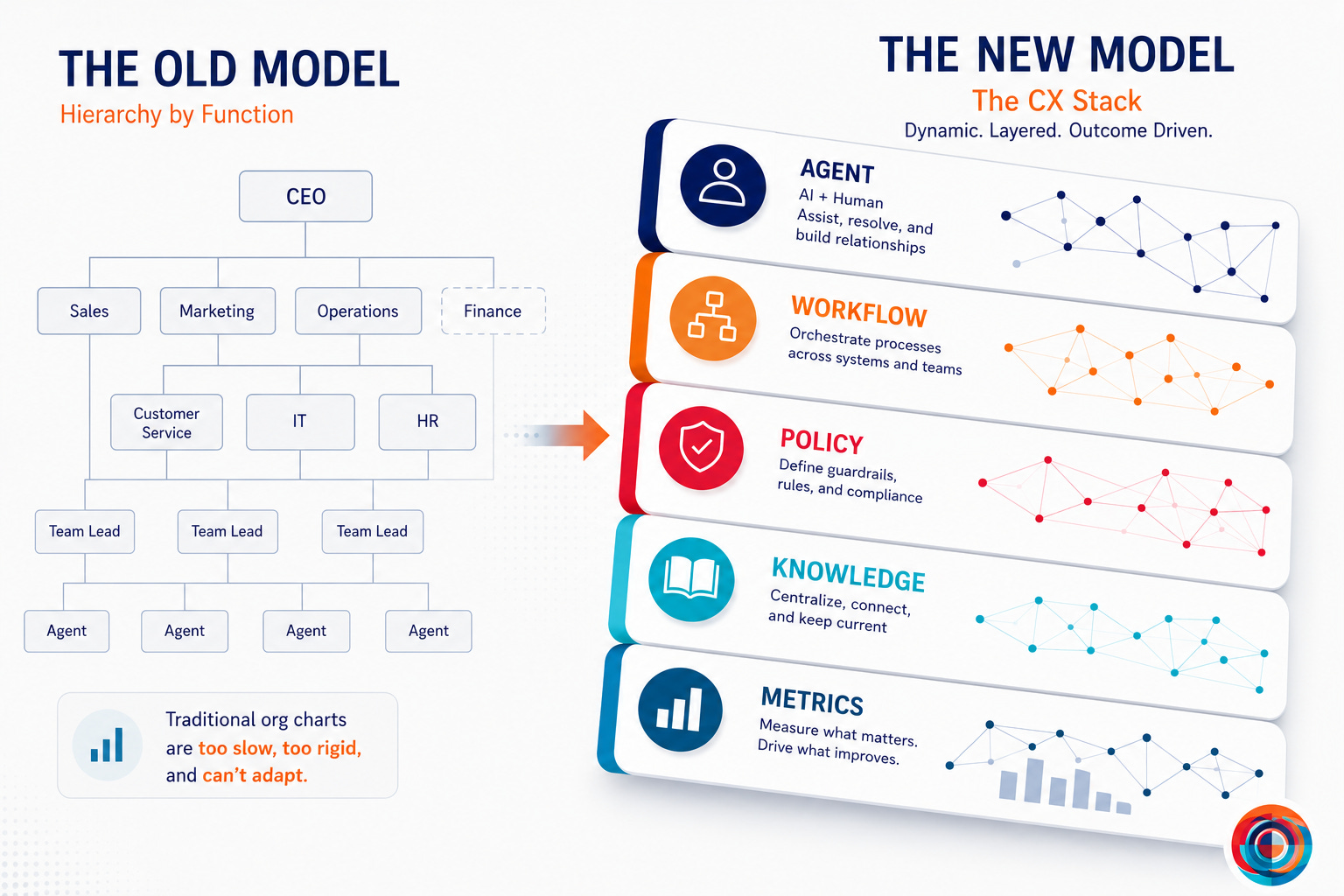
The sharper read: the stack is starting to do what the org chart used to do.
Every time a bot refunds a charge, blocks an offer, or closes a ticket without a human, that’s the stack acting like a manager, not a spreadsheet.
Follow the money and the product language. Salesforce just launched Agentforce Help Agent with pay-per-resolution pricing — you only pay when the AI resolves the issue end-to-end. Zendesk is testing verified-resolution pricing for its own bots and adopting MCP so agents and AI can work across external systems instead of living inside one sealed platform. These moves treat AI agents less like software seats and more like workers who get paid when the job is “done.”
Picture a customer trying to fix a billing problem after a failed bot handoff. The AI has the transcript. The CRM has the account. Billing has the charge. Legal approved the policy. Service owns the apology. Finance owns the write-off. The customer just wants the money corrected and the promise honored.
Who decides?
The stack does.
The stack is not getting a normal software upgrade. It’s becoming a pricing system for labor and a control system for judgment.
For the last decade, most CX stacks were built around three promises: capture the interaction, route the work, and report the outcome. CRM held the record. CCaaS handled the contact. The knowledge base stored the answer. QA scored the interaction. VOC summarized the pain. Analytics made the dashboard look responsible.
The customer still did the integration work anyway.
They repeated themselves across channels. They carried the gap between the billing system and the service policy. They waited while an agent searched three tools and a Slack thread. They absorbed the company’s architecture as effort.
Now AI agents are forcing a different question.
Not “Where does this interaction go?”
Better: What work can this system perform? What judgment can it apply? Who’s accountable when it acts?
That shifts the stack from a map of departments to a market for tasks and authority. Some work goes to humans. Some goes to AI agents. Some judgment gets encoded in policy, prompts, workflows, and vendor logic. And some work gets pushed back onto the customer under the prettier name of self-service.
Every CX stack has an ideology. It decides what the company expects customers to carry and which version of “customer truth” is allowed to drive action.
The org chart used to decide that through departments, budgets, escalation paths, and political gravity. The new stack is starting to decide it in software.
A containment-first stack teaches customers to carry frustration. A handle-time stack pushes emotional debt onto agents. Vendor-led stacks rent average and call it transformation.
Outcome pricing can make vendors share some risk, but only if “resolved” means something more than contained. Interoperability gives the company a fighting chance to keep customer logic from being buried inside one platform’s incentives.
Zendesk’s outcome pricing is more interesting than another AI demo because charging for successful resolutions reframes AI as labor, not software. Better accounting, yes. Clean morality, no. A bot that creates repeat contacts is not cheaper. It’s just cost transfer.
But outcome pricing creates its own trap: “resolved” by whose standard?
If the vendor defines resolution, “success” can become containment with cleaner math. If the customer defines resolution, the economics get harder. If the business defines resolution, the metric may protect the same internal incentives that created the friction. The next fight in CX will not just be over automation. It will be over the definition of done.
Something similar is happening with interoperability. MCP sounds like plumbing because all important infrastructure sounds boring at first. But in CX, plumbing is power. If an AI agent can read tickets, update records, retrieve knowledge, trigger workflows, and move across tools, the question becomes who governs those actions, and whose version of the customer truth wins — the vendor’s, the business’s, or the customer’s.
The CX stack is moving from systems of record to systems of action. That shift turns software decisions into operating consequences.
Systems of record could hide behind reporting. Systems of action create consequences. If the agent refunds the customer, changes an appointment, updates an account, escalates a complaint, suppresses an offer, or gives the wrong policy with confidence, the stack is no longer observing the experience. It is producing it.
The real control point is no longer just the customer record. It’s the decision layer. Whoever owns context, workflow, policy logic, and the definition of resolution stands between customer truth and business action.
The vendor story gets dangerous here. Every platform wants to become the command center for the customer. Command centers have margin. They have lock-in. They make a vendor roadmap look like destiny.
If your CX strategy lives inside the same vendor roadmap as your competitors, you didn’t buy differentiation. You rented average.
The companies that win the next CX stack will not have the longest list of AI features. They will know which decisions are commodity, which decisions are brand, and which decisions are too risky to automate without human authority nearby.
Buy the plumbing. Build the judgment.
Buy transcription, summarization, routing, generic QA, and workflow automation where the market can do it better. But don’t outsource the logic for how you treat customers when the policy says no, the customer expects yes, and the brand promise is suddenly on trial.
Generic AI makes execution cheaper. Differentiation moves to judgment.
The new stack needs a trustworthy knowledge layer because AI turns stale policy into confident damage. It needs an action layer because agents are moving from suggestion to execution. It needs interoperability because no serious CX operation can be trapped inside one vendor’s worldview.
And it needs an authority layer to decide which actions AI can take, which decisions require humans, and what counts as resolved
The problem isn’t AI entering the CX stack. It’s AI entering a stack already designed to export complexity to customers and employees. That’s automation without accountability.
If that happens, the company will not get better customer experience. It will get industrialized evidence of the same old choices.
Use this test in the next CX stack conversation:
When this system acts, who owns the consequence?
Who decided what “resolved” means?
“Vendor owns it” means the company outsourced courage.
“Agent owns it” means the company pushed risk to the lowest‑authority human in the chain.
And if the customer owns it?
Then the stack is just a more expensive way to disappoint people.
The CX stack is changing. The fight is whether it becomes an accountability system or a cheaper machine for making customers carry the spread.
www.marklevy.co
Follow me on Linkedin
What Successful CX Leaders Do on Sundays
DCX Links: Six must-read picks to fuel your leadership journey delivered every Sunday morning. Dive into the latest edition now!
Customers Stall Where Confidence Runs Out
Welcome to the DCX weekly roundup of customer experience insights!
Thanks for being here. I’ll see you next Tuesday at 8:15 am ET.
👉 If you enjoyed this newsletter and value this work, please consider forwarding it to your friends and colleagues or sharing it on social media. New to DCX? Sign Up.
✉️ Join 1,700+ CX leaders who stay ahead of the next customer curve.
Human-centered insights. Plug-and-play frameworks. Smart tools that actually work. All designed for CX pros who want to build with purpose—and deliver with impact.
👉 Subscribe today and get the tools to elevate your strategy (and your sanity).


