When Everything Is Urgent, Nothing Is
A field guide for surviving “quick sync” culture without letting other people’s panic become your backlog.
If you work in CX, you know the day when “urgent” becomes the default setting
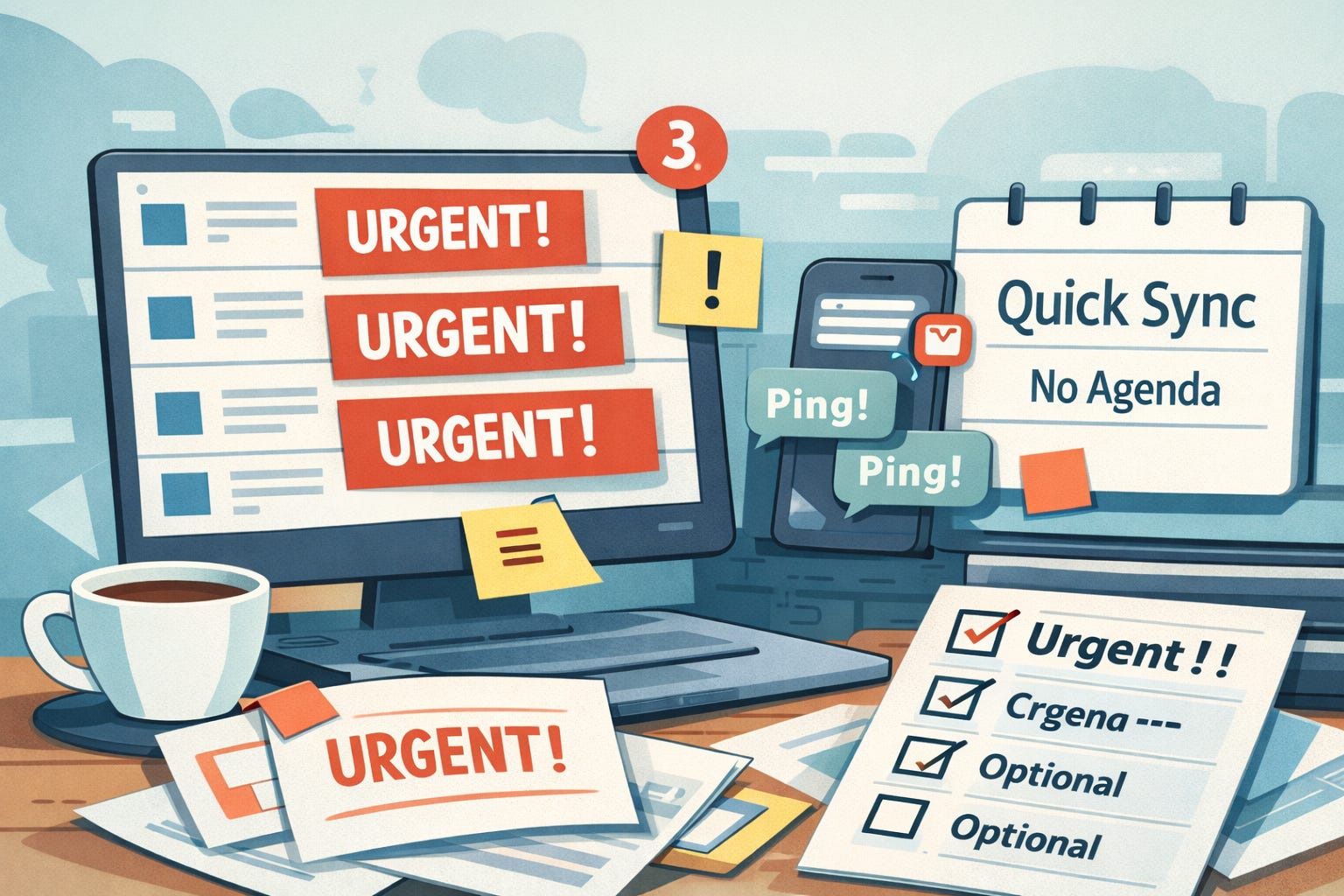
You turn on your screen, and the first thing you see is “URGENT” in the subject line. Then another one. Then Slack starts. Then a meeting invite lands with no agenda and the title is “Quick sync. Important.”
And you’re sitting there thinking… what exactly am I supposed to do first?
When everything is labeled urgent, urgency has lost meaning.
At that point, your job isn’t to run faster. It’s to rebuild the signal so customers don’t feel the cost of internal chaos.
Here are seven ways to cut the noise back down to something workable.
1) Treat “urgent” like a claim. Then test it.
Most urgency arrives as a label, not a fact.
So don’t fight the label. Just translate it.
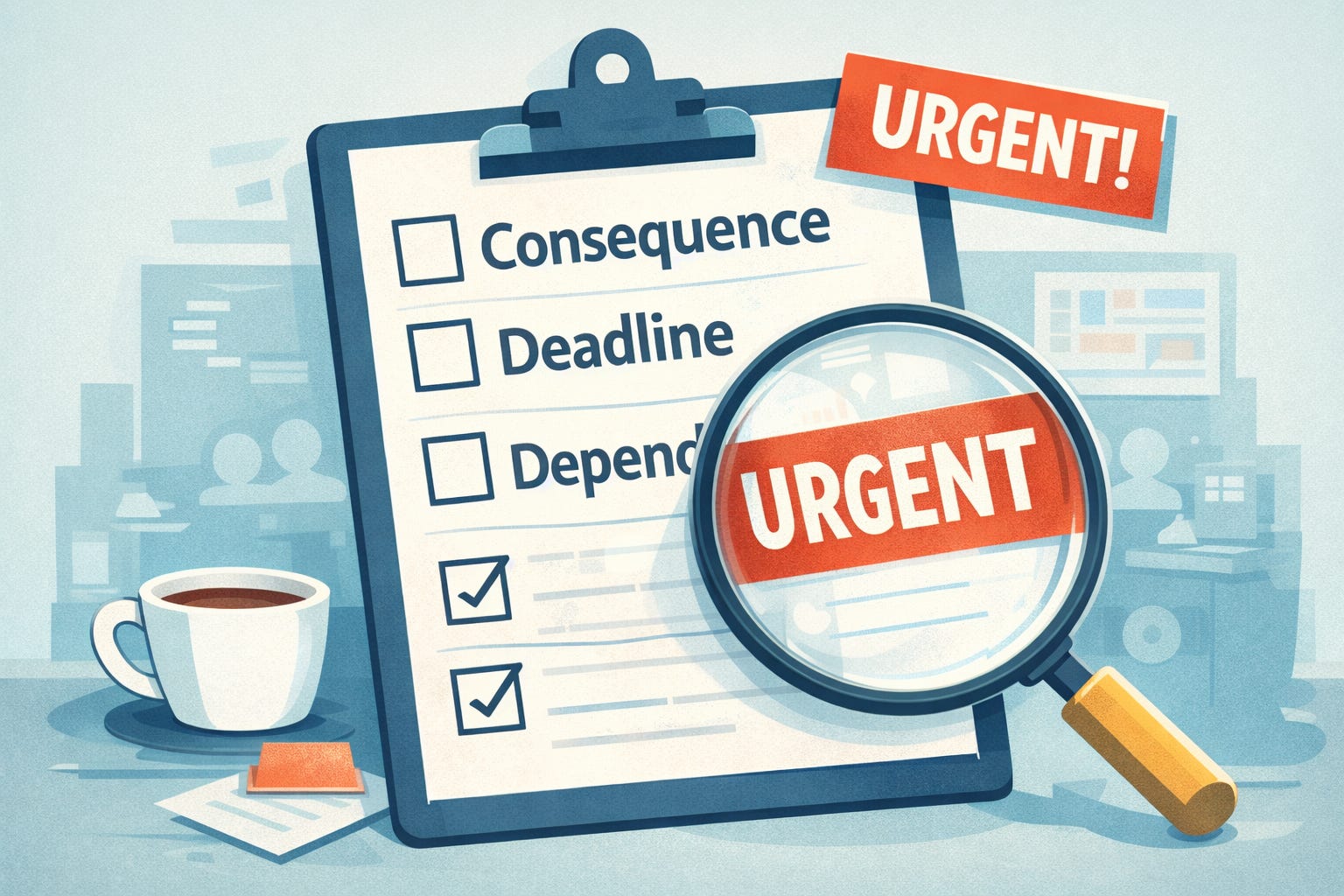
Run each “urgent” request through three quick tests before you commit.
A) Consequence of delay
Ask the simplest question that people weirdly avoid.
What actually breaks if this waits 24 to 72 hours?
Not what feels uncomfortable. Not what annoys someone.
What breaks.
Then ask the follow-up that really matters.
Is the damage reversible or permanent?
True urgency usually has an irreversible consequence. A lot of “urgent” work has a consequence, it just isn’t true.
B) External vs internal deadline
External deadlines deserve the weight. Customers. Regulators. A launch date that can’t move. A public promise.
Internal deadlines often sound urgent but shift constantly. “ASAP” is not a deadline. “EOD” isn’t either if it magically becomes “tomorrow morning” the second you push back.
C) Dependency
Does someone need your output to move forward?
Are you blocking multiple people or a system?
If your work unlocks other work, it compounds. If it doesn’t, it’s usually not as urgent as it sounds.
Quick gut check: if an item doesn’t score high on at least two of these, it’s probably not urgent. It’s just loud.
2) Make it even easier. Use a tiny scorecard.
Keep it simple. You need a fast way to decide without negotiating with your own stress.
Use this.
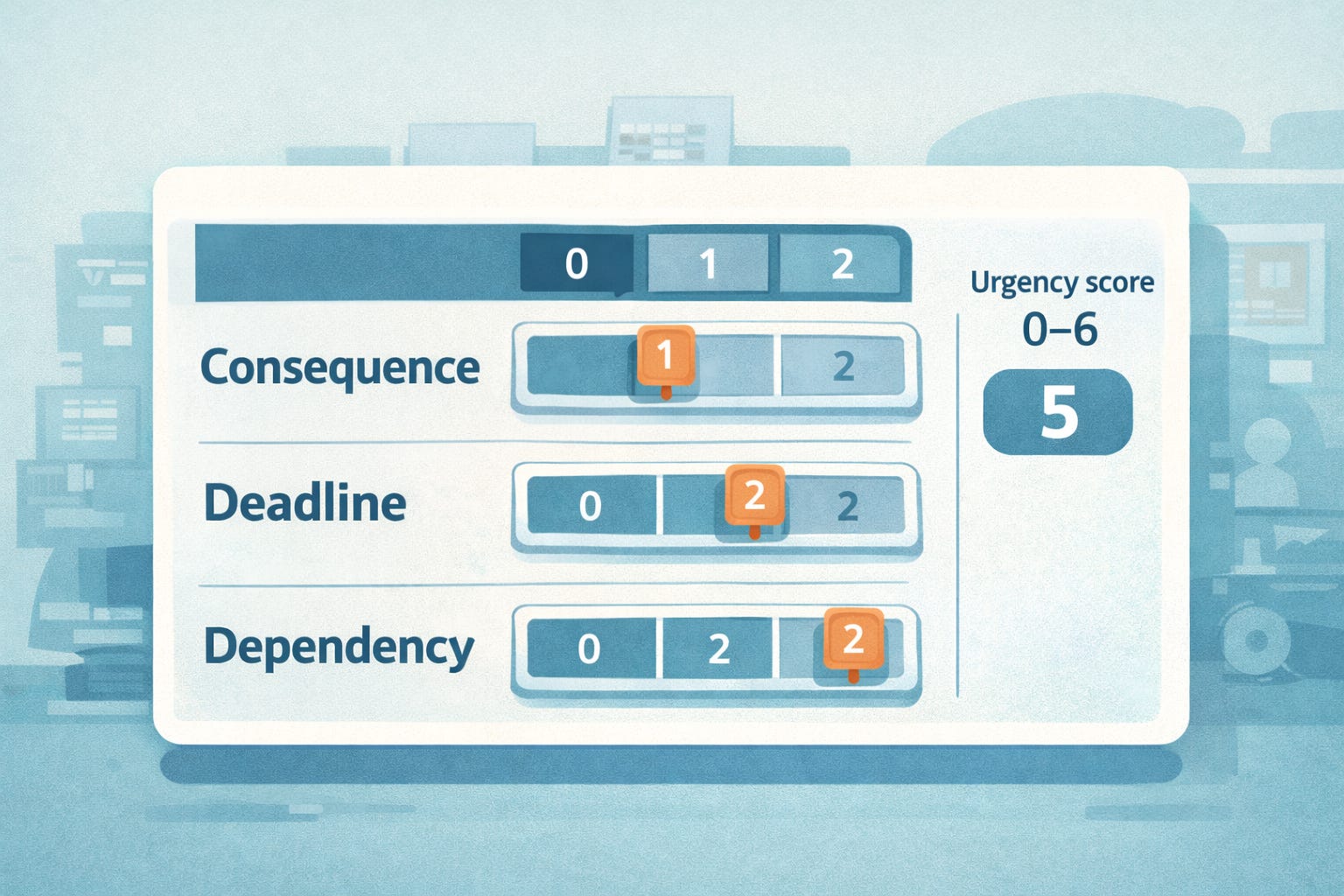
Urgency score (0–6)
Consequence (0–2): reversible (0), painful (1), irreversible (2)
Deadline (0–2): internal (0), fuzzy (1), external hard date (2)
Dependency (0–2): no one blocked (0), one blocked (1), many blocked (2)
Rules
5–6: do today
3–4: schedule it with a timebox
0–2: park it until it’s clarified
What you’ll notice fast is this. A lot of “urgent” work can’t score a 5 without someone stretching the truth.
That’s useful information.
3) When everything still feels tied, use one tie-breaker rule
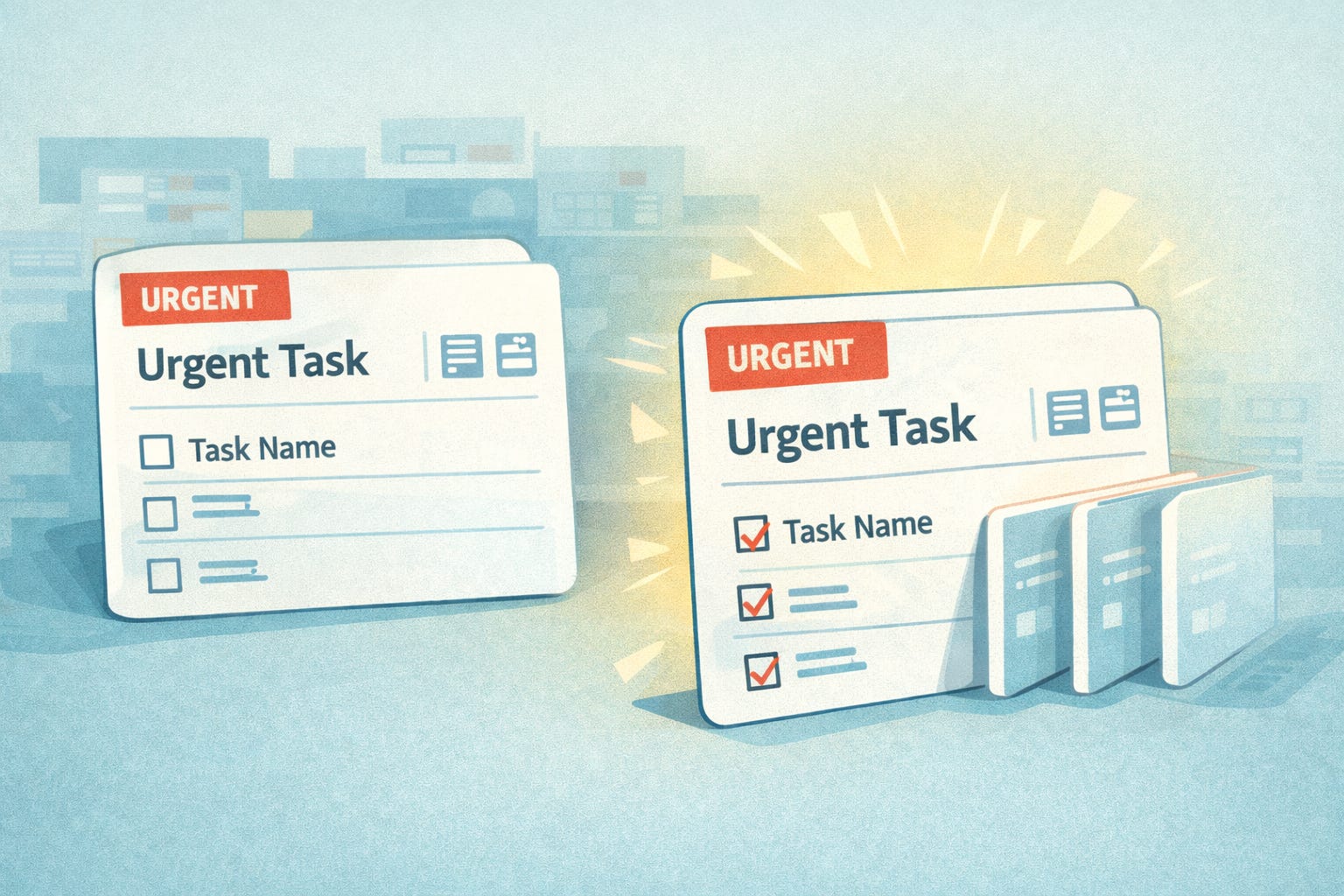
Even with scoring, you’ll end up with a couple of items that look equally pressing.
This is where people either freeze or bounce between tasks all day and end up exhausted with nothing truly finished.
Pick one tie-breaker and stick with it.
My default is:
Do the task that unblocks the most future work or people.
If you prefer another rule, fine. Don’t improvise daily. Pick it once and use it.
Other tie-breakers that work:
Shortest task first (reduces mental clutter)
Closest hard deadline
Highest financial or reputational risk
4) Urgency without boundaries is how days disappear. Timebox it.
This is the part that stops “urgent” from eating your whole day.
For every “urgent” task you accept, force two decisions:
What’s the smallest acceptable version?
How much time will I allow today? (30, 60, 90 minutes)
When the timebox ends, stop.
Unless it’s a true fire. Legal, safety, outage.
Or stopping creates more harm than finishing.
This protects your day from being eaten alive by open-ended “urgent” work that expands to fill everything.
5) Push back with clarity, not defensiveness
People who label everything urgent usually aren’t trying to ruin your day. They’re trying to move their thing up the line.
So don’t argue. Don’t lecture. Give them tradeoffs.
Try these scripts.
Script 1: tradeoff
“I can do A today, which means B moves to tomorrow. Is that the priority?”
Script 2: replacement
“If this must happen today, what should it replace?”
Script 3: the “quick thing” trap
“Happy to help. What’s the customer impact if it waits until tomorrow?”
That last one is my favorite because it forces a real answer. If there’s no customer impact, the urgency tends to melt away on its own.
6) Keep a short Today List. Three to five items. That’s it.
Never prioritize from a giant backlog. It’s a trap.
Make a Today List with a hard limit. Three to five items max.
If you want more structure, use this simple template:
Today List
Customer protection: stops customer harm, repeat contacts, churn risk
Unblocker: frees up other people or teams
Commitment: something you promised with a real due date
optional
optional
Everything else is explicitly “not today.”
If it’s not on the Today List, it isn’t urgent today. Even if it’s noisy.
7) Learn to spot priority theater
Some things look urgent because they’re being performed as urgent.
Be skeptical when:
no one follows up
deadlines keep moving
there’s no clear owner or consequence
“urgent” arrives after hours, but no one escalates through the actual on-call path
Example: someone pings “urgent” at 6:12pm, but they don’t page on-call, don’t open an incident, and don’t reply until lunch the next day.
That’s not urgency. That’s anxiety with a subject line.
Try this for five days
Run a five-day experiment.
Anytime someone labels something urgent, ask for three pieces of info:
Consequence if delayed 48 hours
External deadline (yes or no)
Who is blocked
If they can’t answer, it doesn’t get priority yet. It gets clarified first.
This is a small behavior shift that changes the culture faster than any “we need to prioritize better” meeting ever will.
One line to remember
And look. You’re not a human router for other people’s panic. You’re a CX leader. You’re protecting customers from internal disorder, one decision at a time.
What Successful CX Leaders Do on Sundays
DCX Links: Six must-read picks to fuel your leadership journey delivered every Sunday morning. Dive into the latest edition now!
👋 Help pick next week’s topic
What should I cover next? Hit reply with a number:
Escalations: how to stop “everything is an escalation” from becoming your team’s personality
Stakeholder requests: translating “quick sync” into an actual decision, or killing it politely
VOC: separating real signal from the feedback that is just one loud person with a keyboard
Support ops: handoffs that don’t turn into customer ping-pong
Your choice: tell me the dumbest “urgent” you’ve been handed lately (2–3 sentences). I might feature it and fix it.
I’ll build next week’s issue around the winner.
www.marklevy.co
Follow me on Linkedin
Thanks for being here. I’ll see you next Tuesday at 8:15 am ET.
👉 If you enjoyed this newsletter and value this work, please consider forwarding it to your friends and colleagues or sharing it on social media. New to DCX? Sign Up.
✉️ Join 1,480+ CX leaders who stay ahead of the next customer curve.
Human-centered insights. Plug-and-play frameworks. Smart tools that actually work.
All designed for CX pros who want to build with purpose—and deliver with impact.
👉 Subscribe today and get the tools to elevate your strategy (and your sanity).