
Why Leadership Teams Don’t Fix CX – They Protect the Decisions That Broke It
How customer complaints expose the tradeoffs your organization stopped seeing long ago.
The company’s story vs. the customer’s reality
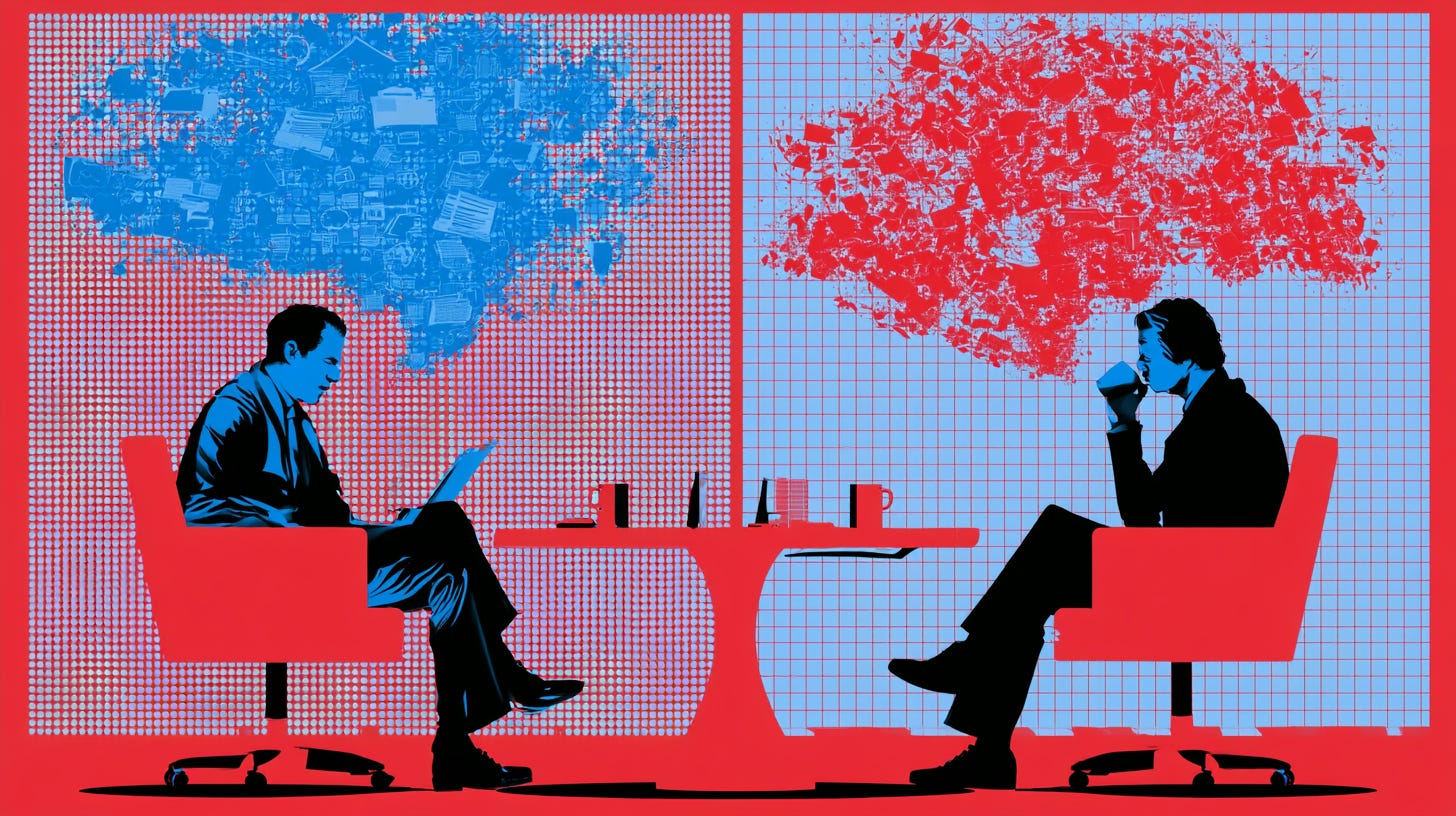
Companies are very good at explaining their own bad customer experiences.
Inside every company, there are reasons for why things work the way they do. A process exists because of a regulatory requirement. A delay is the consequence of a staffing shortage. A policy was created after a costly mistake. A feature was deprioritized because another initiative promised greater return. Inside the company, these decisions look reasonable.
Customers never encounter any of that context.
What they encounter instead is the experience those decisions produce.
This distinction may seem obvious, yet it is at the heart of why so many organizations struggle to understand customer frustration. Businesses often evaluate experiences through the lens of intent. Customers evaluate them through the lens of consequence.
What a billing dispute really teaches your customer
Consider a simple billing dispute.
A customer spots a surprise charge, opens chat, and explains the issue. The agent is friendly but can’t adjust the bill because “billing owns that.” The customer is transferred. The next person asks them to repeat the story and submits a ticket to a back-office team that only works weekdays. Three days later, an email arrives asking for more documentation. By the time the charge is finally reversed, the customer has told the story four times and decided this company is good at excuses and bad at accountability.
Internally, each step in that journey made sense. A control was added after a revenue leak. Segregation of duties was introduced after an auditor finding. Handle time targets pushed teams to move complex issues into queues. Individually, the choices were rational. Together, they created a loop that taught the customer something uncomfortable about what the company really protects.
In each case, the organization’s rationale may be entirely valid. The customer’s reaction may be equally valid. The problem emerges when leaders assume that the rationale somehow travels with the experience.
It does not.
Customers rarely see tradeoffs. They see outcomes.
Complaints aren’t noise – they’re your priorities showing
This helps explain why some forms of customer frustration prove so resistant to improvement efforts. Organizations often treat them as failures of execution when they are, in fact, the logical consequence of decisions that were made elsewhere in the business. The complaint surfaces in customer service, but the source may lie in risk management. The friction appears in a digital journey, but the underlying cause may be an operational objective that was optimized months earlier. What looks like a CX problem is often a business decision showing up as customer effort.
Viewed this way, many customer complaints become more interesting. They are not simply reports of dissatisfaction. They are signals. They reveal where the organization’s priorities become visible to people outside the organization.
Customer behavior often tells the truth before strategy documents do.
Most companies can articulate what they value. They value rowth, efficiency, innovation, trust, and customer focus.. Yet customers do not experience corporate values statements. They experience the practical consequences of how those values are balanced against one another. The actual priorities of an organization are often revealed not by what it says matters, but by what customers are repeatedly asked to tolerate.
What your “billing loop” says about what you really protect
In the billing loop example, the customer wasn’t just annoyed by a fee. They were being shown how the organization balances revenue protection, audit comfort and operational efficiency against fairness and effort. The decision to route adjustments through multiple teams, to enforce strict rules on who can touch what, and to bury resolution in a back-office queue all communicate something clear: the company chose internal certainty over external simplicity.
The point is not that these tradeoffs are wrong. Every business operates under constraints, and every leadership team must make difficult choices. The more interesting question is whether those choices are understood as tradeoffs at all.
Over time, organizations have a tendency to institutionalize their decisions. What began as a deliberate choice gradually becomes accepted as the natural order of things. Complexity becomes normal. Friction becomes expected. Processes that were originally designed to address a specific concern become permanent features of the customer experience. Eventually, few people remember that an alternative ever existed.
CX work as an antidote to organizational amnesia
This is one reason customer experience work can be so valuable. At its best, it challenges organizational amnesia. It reminds leaders that many aspects of the customer journey are not inevitable. They come from decisions, incentives, and assumptions leaders can revisit.
That requires a different kind of conversation than the one many organizations are accustomed to having. Instead of asking why customers are frustrated, leaders must sometimes ask what priorities made that frustration predictable. Instead of treating complaints as isolated events, they must examine the operating choices that repeatedly generate them. Most importantly, they must resist the temptation to explain customer effort solely through the constraints of the business.
Customers do not experience constraints.
They experience what those constraints become.
That may be the most useful lens for understanding customer experience in an increasingly complex business environment. As companies automate more service decisions, customers will feel more choices they cannot see. The challenge for leaders is not simply to understand what customers are feeling. It is to understand what those feelings reveal about the fraud rule, staffing model, incentive plan, or automation target behind the complaint.
Because customers may never know what a company intended.
But they become experts in what the company chose to protect.
How to use this tomorrow
If you want this to be more than an interesting idea, start small and specific.
Take one stubborn complaint that keeps showing up in your data. It might be a billing loop like the one above, a failed onboarding, or a channel hop where customers bounce between a bot and a live agent.
First, trace that complaint upstream in plain language. In the billing example, who decided frontline agents couldn’t adjust certain charges? Who required a second team to approve credits? Who set the service levels for back‑office queues? What problem were they trying to solve at the time?
Then write the tradeoff as a single sentence: “We chose this level of control and revenue protection for us, knowing it would mean this level of effort and delay for customers.” Put that sentence in front of your leadership team. If people are uncomfortable saying it out loud, that’s a signal.
Next, ask: knowing what we know today about our strategy and our customers, would we still make that same choice? If the honest answer is no, the work is to change the decision, not to patch the experience around it. In the billing case, that might mean raising credit thresholds, simplifying approval rules, or moving certain fixes into the first line instead of a back‑office queue.
Finally, look for the metric or incentive that will quietly drag you back to the old choice. What are you measuring, rewarding, or fearing that keeps this decision in place? A revenue protection target, an audit finding, or a productivity metric that silently wins every argument will keep recreating the complaint under different names.
Run that exercise on one complaint this week. Then another. Over time, you stop treating customer frustration as noise and start using it as a map of the choices your organization has been protecting.
www.marklevy.co
Follow me on Linkedin
What Successful CX Leaders Do on Sundays
DCX Links: Six must-read picks to fuel your leadership journey delivered every Sunday morning. Dive into the latest edition now!
Thanks for being here. I’ll see you next Tuesday at 8:15 am ET.
👉 If you enjoyed this newsletter and value this work, please consider forwarding it to your friends and colleagues or sharing it on social media. New to DCX? Sign Up.
✉️ Join 1,700+ CX leaders who stay ahead of the next customer curve.
Human-centered insights. Plug-and-play frameworks. Smart tools that actually work. All designed for CX pros who want to build with purpose—and deliver with impact.
👉 Subscribe today and get the tools to elevate your strategy (and your sanity).


