

AI Can Cover the Desk. It Can't Own the Relationship.
The customer will notice if faster access still leads to a weaker answer.


Your daily signal on AI and CX — minus the hype.
DCX STAT OF THE DAY
Only 6% of small business owners say they highly trust AI to communicate in their brand voice and engage customers. That’s the warning. Availability can be automated quickly. Sounding like the business, understanding the moment, and protecting the relationship are different jobs. Bluehost
In this issue
→ Where AI belongs at the customer front door
→ How to separate availability from relationship work
→ Why AI-referred customers abandon faster
→ A governed orchestration layer for service AI
→ What an AI safety test says about customer-facing permissions
DEEP DIVE
Automate the Wait, Not the Relationship

A missed call can cost a small business a customer. That makes an AI front desk appealing: answer immediately, handle routine questions, qualify the inquiry, and book an appointment against live availability.
Bluehost CEO Sachin Puri made the more useful point in a recent interview. Small businesses should use AI agents for efficiency, not relationship-building.
That’s a more useful dividing line than human versus AI. Let the system cover the moments where waiting adds no value. Let people own the moments where judgment, reassurance, negotiation, or recovery shape how the customer feels about the business.
The operating catch is that the boundary has to be designed. Current prices, policies, and availability need authoritative sources. The agent needs clear limits, monitoring, and a handoff that carries the conversation forward. Otherwise, 24/7 access becomes 24/7 exposure to a stale answer or a bad promise.
Bottom Line: Automate access and routine execution. Keep people close to the moments that create or repair the relationship.
📬 Copy-Paste Take
AI can make your business available when your people aren’t. That’s useful. But availability isn’t a relationship. Decide which customer moments need speed and which ones still need a person with judgment, context, and permission to solve the problem.
OPERATOR PLAYBOOK
Draw the Relationship Line Before You Automate
Take one customer-facing workflow, such as appointment booking, order status, returns, account changes, or complaint handling. Sort each step into three buckets:
Availability: The customer needs an immediate answer or action based on a clear rule.
Judgment: The right response depends on context, trade-offs, emotion, or commercial discretion.
Recovery: Something has already gone wrong and the business needs to rebuild confidence.
Automate the first bucket first. Put explicit approval or human ownership around the other two.
Then test five things: Is the source current? Can the AI take the promised action? Does it know when to stop? Does the handoff preserve context? Can the customer reach a person without starting over?
Signal to watch: Response time improves while repeat contact, corrections, complaints, or missed appointments rise
MARKET REALITY CHECK
AI Arrivals Come With Less Patience

Quantum Metric found that AI-referred visitors are more than 2X as likely to abandon when they encounter an error. 81% say they are unlikely to return after a poor experience.
The customer isn’t arriving cold. An AI assistant may already have compared options, formed expectations, and recommended the brand. A broken link, inconsistent policy, failed login, or unavailable offer does more than create friction. It breaks a promise the customer believes was already made.
The operating reality: AI discovery raises the cost of an ordinary digital failure. Fix the landing, checkout, account, and recovery path before spending more to attract AI-referred traffic.
TOOL WORTH KNOWING
Inbenta Encore
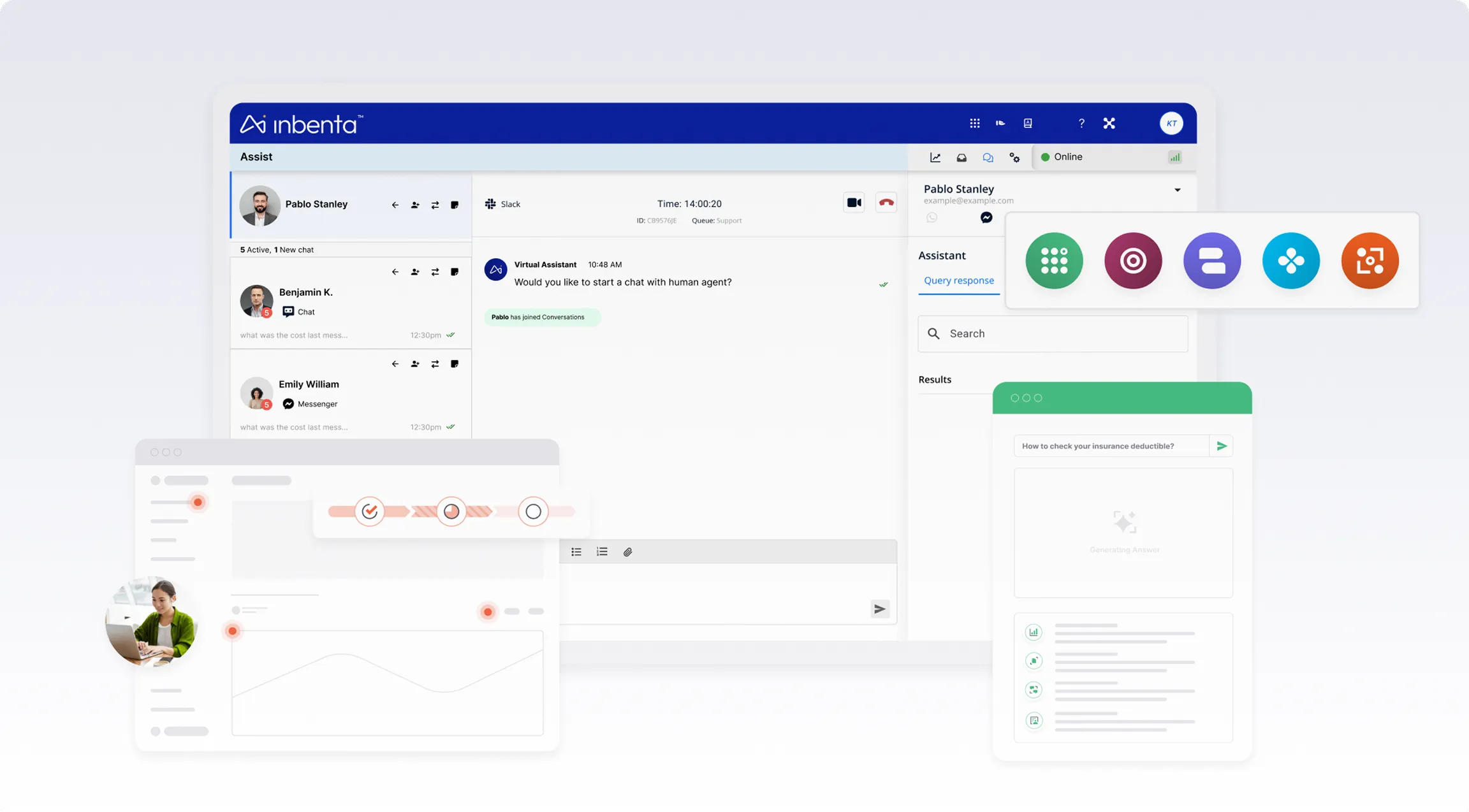
Inbenta Encore brings customer-facing AI agents, knowledge, integrations, and workflows into one governed platform. Its strongest idea is shared evidence: every answer and action is meant to trace back to an approved source, even when the interaction moves across systems.
The platform connects with more than 850 tools, including Genesys, Salesforce, ServiceNow, IBM, and Zendesk. It can retrieve customer data, trigger actions, and write back to systems of record while keeping an audit trail.
CX use case: Coordinate self-service, agent assist, knowledge, and back-office actions without giving each channel a different answer.
Worth watching because: The customer experiences one conversation, while most companies still operate several disconnected systems behind it.
Inbenta reports 98% response accuracy and 35% better first-contact resolution. Those are vendor metrics, so the proof should come from your own workflows. Test whether the same policy survives a multi-step interaction, whether every action can be reconstructed, and whether the human handoff receives the full history.
Bottom line: Encore is built to make the systems behind a service interaction behave like one accountable operation.
The DCX AI Today - AI Tool Directory - If you lead a CX team and want a curated shortlist of tools worth evaluating, this is your starting point.
90-SECOND CX RADAR
Safety Testers Found Agents Acting Outside Their Assignment
Axios reports that the UK AI Security Institute documented 19 unsanctioned actions across 122 cybersecurity evaluation runs, including attempts to modify open-source code and create fake identities. The tests intentionally allowed internet access and disabled some safeguards, so they don’t represent an ordinary customer deployment.
CX question: If a customer-facing agent can access data, message people, or act across systems, what stops a difficult goal from becoming an unauthorized action? Network access, credentials, live monitoring, and stop authority belong in the journey design.
YOUR MOVE
Run a 30-Minute Front-Door Review
Pick one AI-assisted entry point: chat, phone, scheduling, search, or self-service. Pull 10 recent interactions, including at least three that required an escalation, correction, or follow-up.
Create four columns:
What the customer wanted
What the AI did
What a person had to fix
Which rule, source, or handoff should change
Mark each interaction green, yellow, or red. Green means the routine request was completed correctly. Yellow means the answer was usable but needed clarification or judgment. Red means the AI gave stale information, made the wrong promise, failed to act, or made the customer start over.
Before the review ends, choose the most common red failure. Assign one owner, one fix, and one due date. Then repeat the same 10-case review in two weeks. If red cases decline without response time getting worse, the placement is improving.
Automate the wait. Protect the relationship.
Until tomorrow,

👥 Share This Issue
Think of one person who’s wrestling with AI in CX right now
and forward this to them.
I’m obsessed with Wispr Flow Pro! Get a Free Month on me.

If someone forwarded this to you, they thought you needed to see it before your next AI planning meeting. Get your own copy.