

Bring the Human In Before the Damage
Speed is useful. Waiting too long to admit the customer needs judgment is where the experience starts to crack.


Your daily signal on AI and CX — minus the hype.
DCX Stat of the day: In a Taobao field experiment covering 680,676 online service chats, agentic AI made service faster overall, but did not improve service quality for AI-eligible chats. Tuck School of Business
In this issue:
→ Human-in-the-loop isn’t a magic wand
→ Frustration changes the handoff
→ AI referrals raise the landing-page bar
→ Commerce tools move beyond the website
→ Recovery needs earlier ownership
🔍 DEEP DIVE
The Rescue Window Closes Fast
Tuck’s Lauren Xiaoyuan Lu looked at a Taobao experiment where agentic AI handled customer-service chats while human agents monitored the work and stepped in when the system flagged trouble.
The useful part is where the handoff broke. When escalation happened because the AI hit a technical limit, humans could still preserve service quality. But when escalation happened after the customer was already frustrated or skeptical, recovery got much harder. Ratings dropped. Follow-up contacts rose. Agents also appeared to put in less effort once the customer emotion had already gone sideways.
That is the customer-experience lesson. “Human in the loop” only works if the human enters while the relationship is still recoverable. If the customer has already spent ten minutes arguing with the bot, the human is not receiving a clean handoff. They are inheriting damage.
Bottom Line: Escalation is part of the product. Timing decides whether it feels like help or cleanup.
📬 Copy-Paste Take
Before we call any service AI “human supervised,” we need to define the rescue window. What customer signals trigger an immediate human? What frustration markers end the automation? What does the agent see when they step in? A human handoff after the customer is already mad is not oversight. It is damage control.
🧭 OPERATOR PLAYBOOK
Write the Stop Rule First
Audit every AI-assisted service flow for four things:
The first signal that the customer is confused.
The first signal that the customer is emotionally done.
The exact moment automation must stop.
The context a human needs to recover the relationship.
Then test whether your escalation logic catches frustration before the customer starts repeating themselves, changing channels, or asking for a manager.
Ask your team: Are we measuring how fast AI answers, or how early it gives up when the customer needs judgment, empathy, or authority?
Signal: If the human only appears after failure is obvious, the design is late.
📊 MARKET REALITY CHECK
Borrowed Intent Is Easy to Waste

Retail Dive’s Adobe Commerce-sponsored July 13 piece points to a commerce shift worth watching: AI-referred shoppers can arrive with unusually clear intent. The article cites Adobe-backed metrics that these shoppers convert 42% better than other traffic, have a 27% lower bounce rate, spend 38% longer on site, and view 10% more pages per visit.
Treat that as a signal, not gospel. The operating point still matters: AI may do more of the discovery work before the customer reaches you. That means the landing experience has to preserve the intent the assistant created. Slow pages, weak search, vague product data, messy policies, and dead-end support will waste the introduction.
Why it matters: AI is changing where customers discover you. It is also changing how much intent they bring when they arrive, and how quickly your own experience can squander it.
AI referral + bad landing flow = expensive borrowed intent.
🧰 TOOL WORTH KNOWING
Revamp
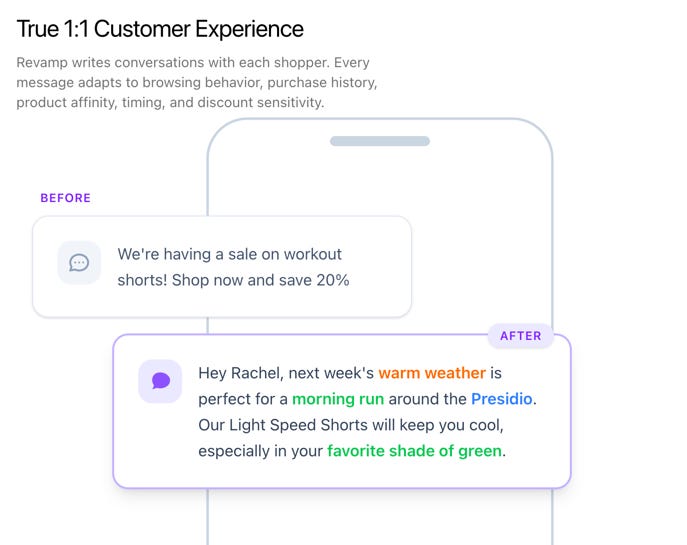
What it does: Revamp uses AI agents to personalize customer engagement across email, SMS, and commerce journeys. It adapts messages to browsing behavior, purchase history, product affinity, timing, discount sensitivity, average order value patterns, brand voice, and product catalog changes.
CX use case: It helps D2C brands move from broad promotional blasts to customer-specific communication that reflects what the customer has actually done, bought, browsed, preferred, and ignored.
Worth watching because: Personalization is usually where customer experience gets weird. Too generic and it feels lazy. Too personal and it feels creepy. Revamp is interesting because it pairs 1:1 message generation with brand voice, product data, integrations, analytics, and guardrails.
Bottom line: If AI is going to talk to every customer differently, the operating question is bigger than “Can it personalize?” It is “Can it personalize without breaking trust, tone, timing, or the business rules?”
The DCX AI Today - AI Tool Directory - If you lead a CX team and want a curated shortlist of tools worth evaluating, this is your starting point.
📡 90-SECOND CX RADAR
Banks Are Splitting on What AI Is For
Visa says 86% of European banking leaders believe AI will reshape retail banking by 2030, but fewer than one in three cite customer experience or fraud prevention as their primary AI driver. That is the split to watch. Some banks are using AI to cut cost. Others are wiring it into real-time decisions customers actually feel.
Why it matters: CX teams should watch whether AI funding is going toward efficiency slides or customer-impacting decision flows.
Chewy Is Turning Pet Care Into an AI Operations Test
Chewy is using AI across customer service, pharmacy operations, fulfillment, marketing, and veterinary-clinic workflows. The clinic examples are the useful bit: AI agents can prepare triage reports, scribe appointments into practice systems, write follow-up notes, and give veterinarians time back.
Why it matters: The CX story is not “AI in retail.” It is what happens when service, clinical context, pharmacy delivery, and post-visit follow-up start sharing the same operating layer.
Even San Francisco Can’t Make AI Adoption Automatic
San Francisco gave roughly 30,000 city employees access to Microsoft Copilot, and city workers sent or received more than 1 million Copilot messages between July 2025 and April 2026. Still, uptake stayed below 50% across most departments.
Why it matters: Access is not adoption. Public-service AI needs role fit, training, verification rules, and clear accountability before residents feel the benefit.
✅ YOUR MOVE
Today’s issue is about timing. AI can make service faster and discovery smarter, but speed does not rescue a customer who already feels trapped.
The pattern is the same in support and commerce: intent has to be preserved before it turns into frustration.
This week, pick one AI-assisted journey and inspect the first failure signal. Not the final escalation. The first small sign that the customer is confused, skeptical, angry, stuck, or about to switch channels.
Then make the owner name what happens next:
Does automation keep talking?
Does a human enter early?
Does the employee receive the history?
Does the customer have to start over?
Does anyone own the recovery?
The moment to save the experience is before the customer has to prove it is broken.
Until tomorrow,

👥 Share This Issue
Think of one person who’s wrestling with AI in CX right now
and forward this to them.
I’m obsessed with Wispr Flow Pro! Get a Free Month on me.

If someone forwarded this to you, they thought you needed to see it before your next AI planning meeting. Get your own copy.