

The Agent Role Problem Nobody Is Solving
Plus: When Five Eyes intelligence agencies warn about your AI deployment, CX teams should probably listen.


Your daily signal on AI and CX — minus the hype.
Join me next Tuesday, May 19, for a lively discussion.

📌 DCX Stat of the Day: 85% of customer service and support leaders are expanding human agent responsibilities as AI reduces contact volume — yet only 31% are planning AI-driven layoffs through Q1 2027. Gartner
In this issue:
→ Workforce redesign without role definition is just downsizing
→ Five Eyes issued agentic AI guidance. CX should read it.
→ 64% say their tools slow them down. Redesign won't fix that.
→ Amperity: why bad data is the real AI failure mode
→ ServiceNow, Microsoft, and the governance gap closing in
🔎 Deep Dive
You’re Redesigning Agent Roles. Into What, Exactly?
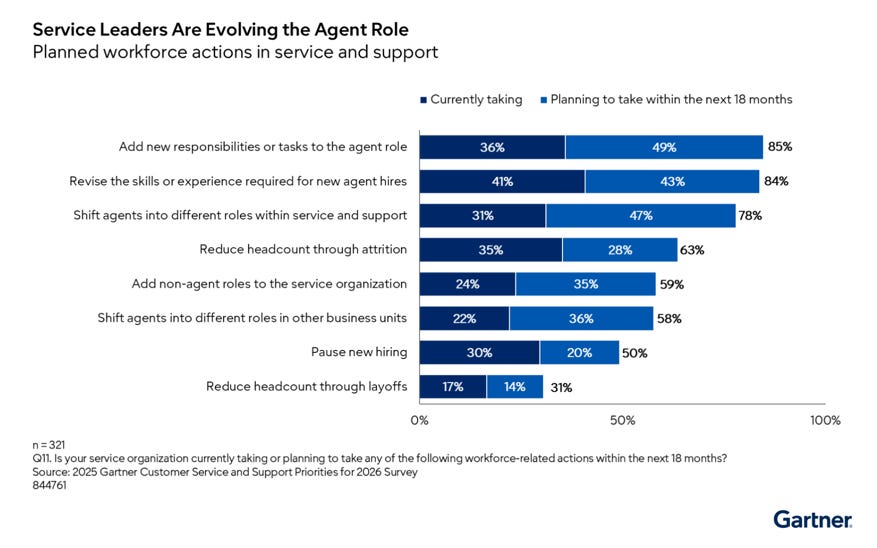
A new Gartner survey of 321 customer service and support leaders confirms what most of us quietly suspected: the mass layoff story was mostly noise. Just 31% of leaders have implemented or plan AI-driven layoffs through Q1 2027. The dominant response is workforce redesign — 85% are expanding what human agents do, and 75% are moving agents into entirely new roles.
Here’s what the survey does not tell you, and where the real work starts. Redesigning the role sounds like a strategy. Often, it’s a delay. “Higher-value interactions” is the phrase that shows up everywhere. But higher-value means different things to different functions, and without a clear answer from the business, agents end up doing the same work in a smaller team while AI handles the easy stuff. That is not a redesign. That’s drift.
Gartner’s own guidance puts it plainly: service leaders must decide whether to do the same work at lower cost or redeploy human agents into roles AI cannot replace and that customers value most. That’s a clean framing, but the hard part is the second option. Most organizations don’t have a clear answer for what “roles AI cannot replace” looks like in their environment — which skills, workflows, and customer relationships.
The practical risk here is timing. 50% of leaders say they have paused or plan to pause hiring within the next 18 months. If the role definition doesn’t happen before the hiring freeze, you’ll have a smaller team with no clearer mandate than the old one. The window is narrower than it looks.
📬 Copy-Paste Take
Forward this to your HR, operations, or workforce planning lead:
“85% of service leaders are expanding agent responsibilities as AI takes over routine work — but the risk isn’t the technology, it’s the absence of a clear role definition before hiring freezes hit. If we don’t decide what our human agents are best at and design the job around that, we’ll end up with a smaller team doing a vaguer version of the old job.”
OPERATOR PLAYBOOK
Before the Hiring Freeze, Define the Role
The window between “AI is reducing volume” and “we’ve paused hiring” is where the workforce redesign either happens or gets skipped. Most teams are in that window right now.
Audit every frontline agent workflow for four things:
Which tasks AI is already handling reliably — not in theory, but in your actual environment, measured by resolution rate and escalation frequency.
Which tasks require human judgment that is genuinely hard to replicate: policy exceptions, emotional complexity, multi-system problem-solving, relationship continuity.
Which tasks are still being done by humans because nobody decided otherwise — not because they need to be.
Which skills your best agents already demonstrate that could translate into cross-functional roles: QA, knowledge management, journey analysis, or internal coaching.
Then test whether your current job description for a frontline agent still describes the role you actually need — or the role you had five years ago.
Ask your team: If AI handles everything routine by end of year, what are your highest-performing agents best equipped to do that AI cannot? Can you describe it in concrete terms a hiring manager could use?
Signal: The organizations that will win this transition are not the ones cutting fastest. They’re the ones deciding first.
📈 Market Reality Check
The Tools Problem Nobody Mentions in the Redesign Conversation
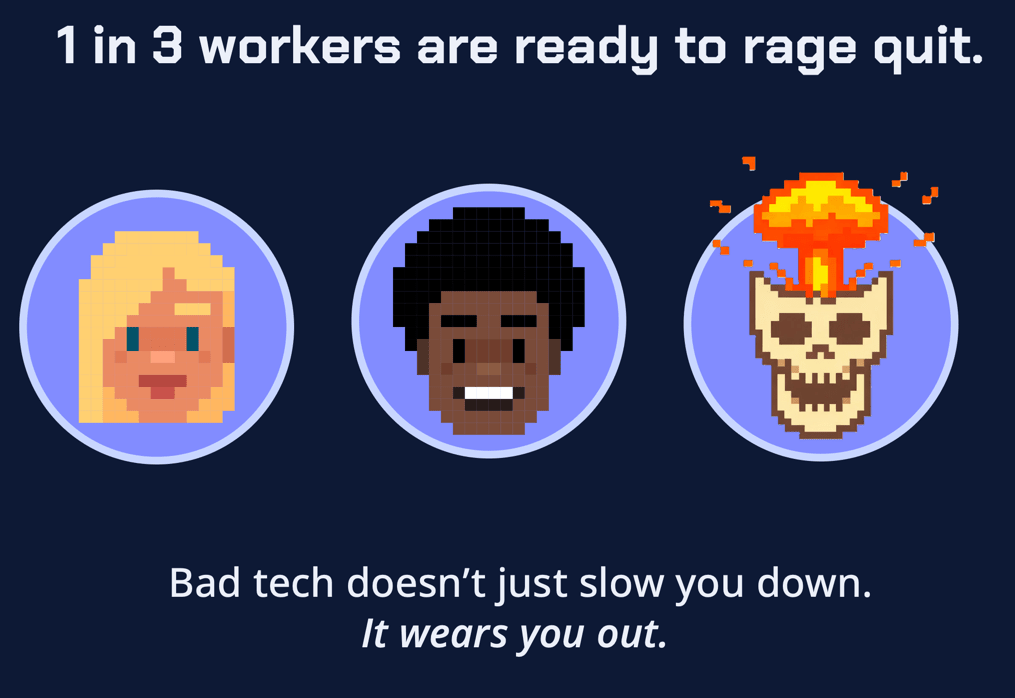
A Pega/YouGov study of nearly 2,600 working adults in the US and UK, found that 64% say their workplace tools erode productivity or slow them down. Fewer than half — 41% — describe their tech as effective. More than a third would consider leaving their jobs if their technology needs aren’t met.
This matters directly to the workforce redesign conversation. You can redefine what human agents are supposed to do, but if the tools they’re working with are still slow, fragmented, and frustrating, the redesign fails on arrival. Agents absorbing higher-complexity work need systems that actually support that work. Right now, most don’t.
You can’t redesign the role without fixing the tools it runs on.
🧰 Tool Worth Knowing
Amperity
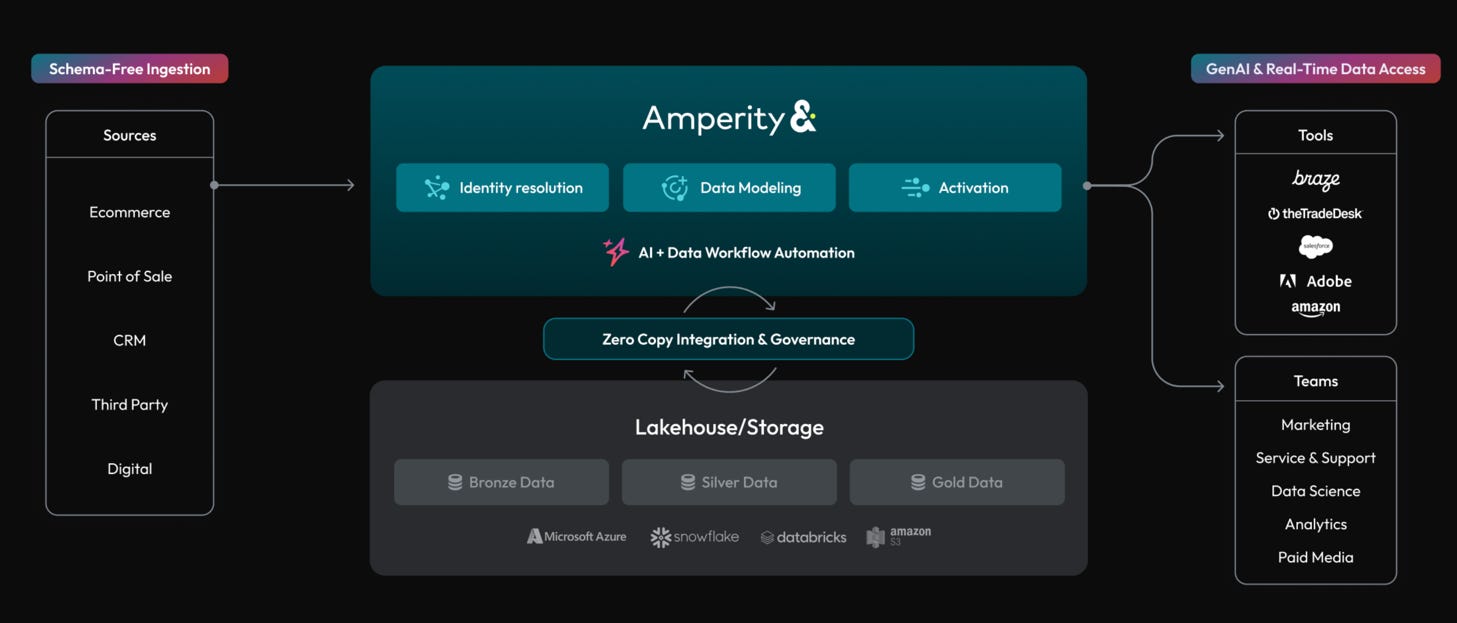
What it does: An AI-powered customer data cloud that builds unified customer profiles by resolving identities across online and offline data sources, then activates those profiles across 200+ downstream destinations — marketing, personalization, loyalty, and service channels.
CX use case: If your AI agents are making decisions about customers — routing, personalization, proactive outreach, loyalty treatment — the quality of those decisions depends entirely on the quality of the data underneath them. Amperity addresses the upstream problem: fragmented, unresolved customer records that make AI look smarter than it is. Alaska Airlines used it to merge 6 million loyalty members from two brands into one profile set, tripling loyalty conversion rates.
Worth watching because: The “agent-powered” framing in their Spring 2026 release is pointed — they’re positioning customer data as the foundation agentic CX actually runs on. That’s the right argument at the right time.
Bottom line: Most AI CX failures are data failures wearing a technology costume. Amperity attacks the root cause.
⚡ 90-Second CX Radar
ServiceNow and Accenture Launch Forward-Deployed Engineering for Agentic AI
Announced May 6 at Knowledge 2026, this program puts ServiceNow and Accenture engineers inside enterprise clients to build agentic workflows in production — not pilots. 300+ pre-built agent skills, governed through ServiceNow’s AI Control Tower. If your agentic roadmap is still in the lab, this is what your competitors are doing instead.
Microsoft’s Three-Agent Contact Center Architecture Is Now Live
Dynamics 365 now ships a coordinated system: frontline self-service, real-time QA across AI and human interactions, and operations configuration. Customer Assist and QA are generally available; Service Operations is US-only preview. The “single connected experience” framing is right. Whether it survives enterprise data complexity is the question every buyer should ask before signing.
Five Eyes Agencies Warn Agentic AI Deployments Outpace Governance
CISA, NSA, and allied agencies across five nations issued their first joint agentic AI guidance on May 1. The CX read: every agent touching customer accounts or service data needs a documented access inventory and a shutoff plan. Assume agents may behave unexpectedly until your governance says otherwise.
🧭 Your Move
The same Gartner data that says 85% of leaders are expanding agent roles also says half of those same leaders are planning a hiring pause. That combination is only safe if the role definition comes first. It rarely does.
This week, pick one frontline workflow where AI is already active or planned. Map what stays human, what transfers to AI, and what the human agent does next. Don’t do it for every workflow — just one. See if you can describe the outcome in terms a hiring manager or a board member could act on.
“Redesign without definition isn’t transformation. It’s just a smaller team waiting for clarity that never came.”
Until tomorrow, Mark Levy DCX AI Today
📤 Share this issue with a colleague who’s navigating the agent workforce question.
Was this forwarded to you? Subscribe to DCX AI Today
NEW: The DCX AI Today - AI Tool Directory - If you lead a CX team and want a curated shortlist of tools worth evaluating, this is your starting point.

👥 Share This Issue
Think of one person who’s wrestling with AI in CX right now
and forward this to them.
I’m obsessed with Wispr Flow Pro! Get a Free Month on me.

If someone forwarded this to you, they thought you needed to see it before your next AI planning meeting. Get your own copy.