

The Checkout Button Is Moving Into the Assistant
Plus: when the assistant can recommend, decide, and pay, “good CX” starts sounding a lot like “please show me exactly what I approved.”


Your daily signal on AI and CX — minus the hype.
DCX Stat of the day: AI voice cloning can now replicate a person’s voice with a short audio sample, in some cases as little as ten seconds. TechRadar Pro
In this issue:
→ Checkout moves inside the assistant
→ Voice trust gets very fragile, very fast
→ Confident wrong answers get expensive
→ Brands get judged inside AI answers
→ Smart displays learn to stop being so literal
🔎 Deep dive
The assistant just moved closer to the buy button

Visa has embedded its payment network inside ChatGPT, which means AI agents can help users shop and complete purchases at merchants that accept Visa.
That is a real line-crossing moment.
Yesterday’s assistant helped compare options. Tomorrow’s assistant may pick the brand, check the price, choose the merchant, and ask for permission to pay. Useful? Absolutely. Also the kind of useful that can get weird in a hurry if the customer cannot see the guardrails.
Groceries, diapers, travel, repeat household items, subscriptions, gifts, repairs. These are not abstract “commerce workflows.” They are the little recurring decisions where customers already hate friction, but still want control.
The CX question now gets bigger: did the customer buy, what did the customer approve, what did the assistant infer, what did the assistant do, and how fast can the business unwind it when the result is wrong?
Spending limits, approval prompts, merchant rules, fraud monitoring, receipts, and recovery flows are not boring back-office details anymore. Congratulations to them. They made it to the front of the customer journey.
Bottom Line: Agentic commerce works only when convenience still leaves the customer feeling like the adult in the room.
📬 Copy-Paste Take
If an AI assistant can buy for the customer, CX needs a new checkout standard: clear permission, visible limits, easy correction, and a fast path to unwind mistakes. Faster checkout is not better if the customer feels like control disappeared behind the curtain.
OPERATOR PLAYBOOK
Find the moment AI stops suggesting and starts acting
Pick one AI-assisted purchase, booking, service, or account flow.
Now find the handoff.
Audit every AI-assisted action for four things:
The exact decision the customer is delegating.
The approval step before money, access, status, or commitment changes.
The receipt or explanation the customer gets after the action.
The recovery path when the assistant buys, books, routes, or recommends the wrong thing.
Then test whether a normal customer can tell the difference between suggestion, approval, and completed action without reading a policy page written by three departments and a lawyer.
Ask your team: Where does this experience cross from helpful guidance into delegated authority?
Signal: Strong consumer AI makes the next step easier without making control fuzzy.
📈 Market Reality Check
The confident wrong answer is the expensive one

The dangerous AI answer is not the obviously broken one. Customers can spot nonsense.
The dangerous answer is wrong in a way that sounds polished, specific, and calm. It has the tone of authority. It arrives quickly. It feels like it belongs in the journey.
That is where CX gets exposed.
If AI touches refunds, eligibility, product fit, billing, travel disruption, policy interpretation, or account access, a friendly tone is not enough. The business needs grounded answers, confidence thresholds, escalation paths, and correction loops customers can actually find.
Otherwise the customer acts on bad guidance, the contact center cleans it up later, and everyone pretends this was a one-off. It rarely is.
Why it matters: A wrong answer that sounds certain creates repeat contact, policy confusion, and trust damage. The business may not notice until the customer has already acted on it.
Fluency without verification = trust risk.
🧰 Tool Worth Knowing
Sprinklr LLM Insights
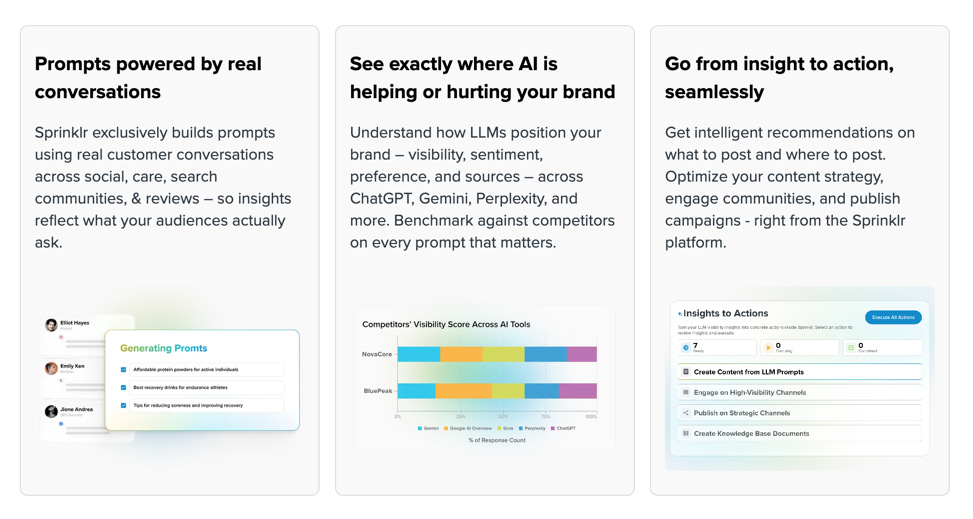
What it does: Sprinklr LLM Insights helps brands see how they show up in AI-generated answers, including visibility, sentiment, recommendations, share of voice, and competitive positioning.
CX use case: When customers ask an AI assistant what to buy, who to trust, or which provider fits their need, brands need to know whether the answer is accurate, incomplete, distorted, or quietly leaving them out of the room.
Worth watching because: Customer discovery is moving into synthesized answers. That means the customer may form an opinion before visiting the brand’s site, seeing the brand’s content, or entering any channel the brand actually measures.
That is a very uncomfortable place to be blind.
Bottom line: If AI answers are becoming the new front door, brands need to know where that door is sending customers before the journey starts crooked.
The DCX AI Today - AI Tool Directory - If you lead a CX team and want a curated shortlist of tools worth evaluating, this is your starting point.
⚡ 90-Second CX Radar
Your Google smart display is finally learning how to hold a real conversation
Gemini for Home is getting more conversational across weather, media, news, reminders, and shopping lists. Translation: customers may be able to stop talking to their smart display like they are trying to appease a very literal toaster.
Why it matters: Voice and home assistants are becoming everyday service surfaces. The bar is moving from “understands commands” to “handles normal human follow-up.”
Gemini Gets a World Cup Stress Test
Gemini is moving into the World Cup fan experience, including real-time search answers, match analysis, stats, and AI-generated fan content. That is a brutal testing ground: emotional, global, multilingual, and very online.
Why it matters: Big live events are becoming test beds for AI-assisted customer journeys. The failure mode is a bad answer at peak attention.
🧭 Your Move
This issue is about consumer AI crossing the authority line.
The assistant is moving toward checkout, product choice, payment, account action, and everyday task completion.
Pick one consumer-facing AI experience this week and map the authority line.
Where does it suggest?
Where does it decide?
Where does it act?
Where can the customer pause, reverse, or recover?
If that line is fuzzy inside your own team, it will be even fuzzier to the customer. And the customer will not grade you on your architecture diagram.
The future of consumer AI depends on making the next step easier without making control harder to find.
Until tomorrow,

👥 Share This Issue
Think of one person who’s wrestling with AI in CX right now
and forward this to them.
I’m obsessed with Wispr Flow Pro! Get a Free Month on me.

If someone forwarded this to you, they thought you needed to see it before your next AI planning meeting. Get your own copy.