

What Happens After AI Takes the Easy Calls?
Carvana keeps cutting service costs. The harder customer problems are the part to watch.


Your daily signal on AI and CX — minus the hype.
DCX Stat of the day: 83% of consumers say they still have to repeat themselves at least sometimes when an AI interaction moves to a human agent. Inside the company, that may count as one AI interaction and one agent interaction. To the customer, it is still one problem that hasn’t been solved. Source: Five9
In this issue
→ What Carvana’s shrinking savings curve reveals
→ How to measure the harder cases left behind
→ Why resolution still trails AI availability
→ Self-service that carries the investigation forward
→ Google learns where AI editing does not belong
Deep dive
The Last 10% May Be the Hard Part

Carvana says its AI customer-experience agent, Sebastian, helped reduce customer-care costs by 40% year over year three years ago. The reductions kept coming, but they got smaller: another 30%, then 20%, then 10% this year.
At first glance, that looks like diminishing returns. I think it also says something important about the work left behind.
The obvious contacts are usually the first to go: repetitive questions, simple status checks, and routine steps. What remains is messier. A delivery exception. A financing question. A trade-in problem that crosses systems. A customer who has already tried three times.
Carvana hasn’t published the customer measures needed to judge the full result. We don’t know the resolution rate, repeat-contact rate, satisfaction change, or how much of the savings came from Sebastian rather than other process improvements.
That missing data matters. As automation removes easy contacts, the average problem reaching a person gets harder. If staffing, authority, and training don’t change with that mix, the customer with the hardest problem can end up funding the efficiency gain with more effort.
📬 Copy-Paste Take
AI can remove a lot of easy service work. Good. Now show me what happened to the customers whose problems were too complicated to automate. That is where the next CX improvement, or the next hidden cost, will be.
OPERATOR PLAYBOOK
Put a Customer Curve Next to the Cost Curve
Start by separating the cases AI completes from the cases that still reach a person. Don’t average them together. Then compare the period before automation with the current quarter on five measures:
Problem mix: Which issues now make up the human queue?
Total resolution time: How long from the customer’s first contact to the actual fix?
Repeat contact: How many customers return within seven days about the same issue?
Transfer load: How many teams touch the case before it closes?
Customer outcome: Did satisfaction, complaints, cancellations, or successful recovery change?
Then ask the uncomfortable question: Did AI remove customer effort, or did it remove the easy work and leave the hard part understaffed?
Signal to watch: Cost per contact falls while repeat contact or total resolution time rises for escalated customers.
MARKET REALITY CHECK
Customers Want Speed. They Still Need an Answer.

59% of consumers say they prefer instant, always-available AI service over waiting for a person, but only when it can resolve the issue. Just 24% say their most recent AI service interaction was fully resolved by AI alone.
Meanwhile, 55% of businesses say they lack the visibility needed to isolate AI-agent performance.
That means many leaders are optimizing AI without being able to separate fast answers from finished work. A customer who reaches AI at midnight and calls again at 9 a.m. hasn’t received 24/7 service. They have made two contacts.
The operating reality: If containment and escalation live in one average, the average hides the failure.
TOOL WORTH KNOWING
Mosaic AI Self-Service
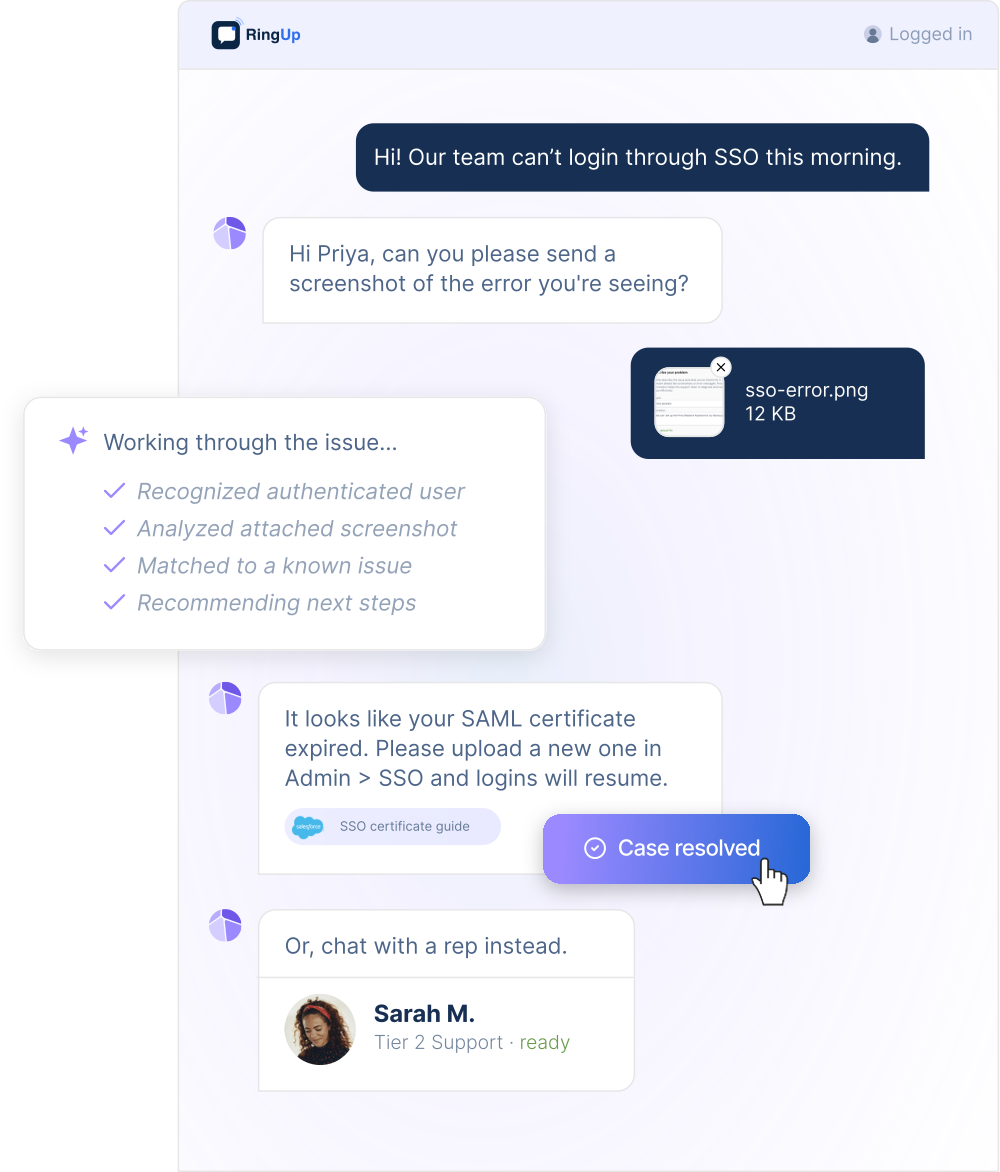
Mosaic uses the customer’s product configuration, case history, messages, and attachments to investigate technical-support questions. It can ask follow-up questions and work through a screenshot instead of offering another generic help-center link.
Its strongest idea is the escalation. When self-service can’t finish the job, Mosaic says the conversation, troubleshooting steps, attachments, and customer context move to the human agent. The useful test is simple: Can that person pick up exactly where the AI stopped?
Mosaic reports that Point of Rental resolves more than 95% of self-service conversations without a case while maintaining customer satisfaction above 90%. Those are vendor-supplied results, so I would test the same promise against repeat contact, reopen rate, and customer effort.
Why it is worth knowing: Count completed customer jobs, not deflected tickets. When escalation is necessary, the customer shouldn’t pay a context tax.
The DCX AI Today - AI Tool Directory - If you lead a CX team and want a curated shortlist of tools worth evaluating, this is your starting point.
90-SECOND CX RADAR
Google Pulled an AI Editor From Google Earth
Google removed a feature that let users alter satellite imagery with AI after researchers showed how easily it could create convincing fake scenes. The problem went beyond misuse. Google Earth is useful because people treat its imagery as evidence. Adding an editing tool weakened that implied promise, even when the output was watermarked.
CX question: Which customer-facing features should AI improve, and which should it leave alone because trust depends on the original being real?
YOUR MOVE
The efficiency dashboard tells you which contacts disappeared. It rarely tells you how the work changed for customers who still needed help.
Those remaining cases are where the next staffing, authority, and recovery problem will show up.
Choose one service workflow where AI has reduced contact volume. Separate AI-contained cases from escalations, then pull 20 escalated cases and check:
Was the problem more complex than cases before automation?
Did the person have the authority to solve it?
Did the customer repeat any part of the story?
How many teams touched the case?
Did the customer have to come back?
The savings curve tells you what disappeared. The customer curve tells you whether the experience improved.
Until tomorrow,

👥 Share This Issue
Think of one person who’s wrestling with AI in CX right now
and forward this to them.
I’m obsessed with Wispr Flow Pro! Get a Free Month on me.

If someone forwarded this to you, they thought you needed to see it before your next AI planning meeting. Get your own copy.