



Your daily signal on AI and CX — minus the hype.
DCX Stat of the day: 44% of surveyed U.S. adults said restaurant automation goes too far when they cannot easily reach a person. PAR Technology
IN THIS ISSUE
→ One conversation now feeds several clinical decisions
→ Review the chain, not just the first output
→ AI investment keeps outrunning operating readiness
→ Give AI decisions a replayable policy trail
→ Billtrust gives AI health signals an operator
🔍 DEEP DIVE
The Visit Doesn’t End When the Transcript Stops
You tell your doctor what hurts. Before you leave, that conversation may be doing more work than either of you can see.
Oracle Health has expanded its Clinical AI Agent in the U.S. with professional-fee coding suggestions, clinician-controlled dictation, and chart review. Oracle says the product can surface history, labs, medications, and other EHR context, while its note-generation capability has saved physicians more than 400,000 hours over nearly two years.
Giving the clinician more time to pay attention to the patient is worth doing. The unresolved part starts after the visit. Suppose the clinician corrects the note after the coding suggestion has already fired. Does billing get the correction? Does the patient summary? Who owns the rework if they don’t?
The patient won’t experience three AI features. They will experience the bill, the follow-up, or the care decision. Edit rates, rejected codes, missing context, correction time, and patient-facing explanations now belong in the same operating conversation.
Bottom Line: A review checkpoint only protects the customer if its correction reaches every system that has already acted.
📬 Copy-Paste Take
“A human reviewed it” isn’t much of an answer. Which human reviewed which output? What evidence did they see? And what happened to the systems that had already used it?
🧭 OPERATOR PLAYBOOK
Follow the Error Past the First Screen
Pick one customer-facing workflow where an AI summary, score, recommendation, or classification gets used somewhere else.
Audit the full decision chain for four things:
Origin: Can the reviewer see the source evidence behind the output?
Authority: Is it clear what the AI can suggest and what it can decide?
Correction: Does one fix update every system that reused the output?
Recovery: Can the customer reach a person before the error becomes a denial, charge, delay, or missed next step?
Plant one believable error near the start. When the first reviewer catches it, keep going. Follow the error into the record, workflow, bill, message, and customer account.
Ask your team: Where does the mistake keep living after someone thinks it has been fixed?
Signal: If the reviewer fixes the note but billing, messaging, or another downstream system keeps the old version, human review hasn’t solved the customer problem.
📊 MARKET REALITY CHECK
The Workflow Changed. Did the Organization?
Only 29% of 102 transformation leaders told Kearney their programs consistently deliver the intended value. More than 80% said fewer than half of their AI initiatives produce measurable financial impact.
The 29% gets the headline. The more useful finding is what was happening inside the work. Resistance to change was the most-cited implementation barrier, and organizations that built capability development in from day one were nearly three times as likely to report the expected value.
That doesn’t prove training caused the result. The sample is small and leader-reported. It does leave a practical question: when the workflow changed, did the company also change the measures, decision rights, skills, and recovery paths around it?
Why it matters: AI investment can make the technology look like the transformation. The harder work is changing roles, measures, skills, and decision rights so the organization can produce a different result after launch.
Operating question: Which capability should be working differently 90 days after launch, and who owns that change?
🧰 TOOL WORTH KNOWING
Penguin AI Context Layer
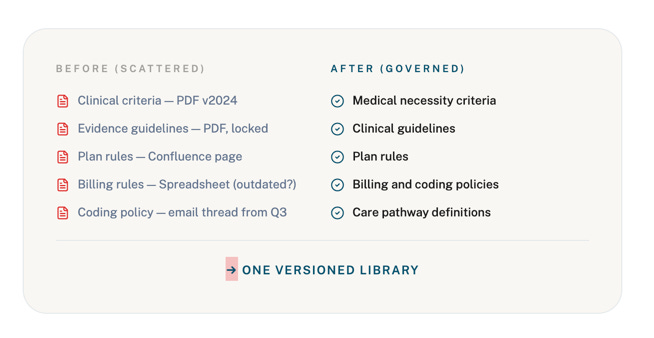
What it does: Penguin AI’s Context Layer turns medical policies, clinical guidelines, and plan rules into one governed, versioned library used across its AI workflows. Each rule retains its source, sign-off, active date, and history.
CX use case: When a patient, provider, or service team challenges a prior authorization or coding decision, the operator can see the policy version, criteria, evidence, and reasoning path that produced it. The same decision can be replayed against the policy that was active at the time.
Worth watching because: Penguin separates the people who author, approve, and deploy a rule. That makes governance part of the workflow. The open question is whether customers and frontline teams can use that trace to resolve a dispute faster, not just defend the original decision.
Bottom line: If an AI decision affects access or cost, the customer should not have to accept “the system said so.” Keep the rule, evidence, and policy version attached to the answer.
The DCX AI Today - AI Tool Directory - If you lead a CX team and want a curated shortlist of tools worth evaluating, this is your starting point.
📡 90-SECOND CX RADAR
Billtrust Is Giving Its AI Signals an Operator
David Karp says Billtrust’s 12-signal customer-health model combines source data, product usage, Gong sentiment, CSAT, NPS, and business-specific risk signals, recalculated weekly. He says it was 84% accurate in Q1. The company is also creating Product Value Architects to turn those signals into interventions alongside CSMs who know the customer’s goals and KPIs.
Why it matters: Prediction becomes useful when someone owns the move from risk score to customer value. The new role may be the bigger CX story than the model.
✅ YOUR MOVE
Start with one AI-generated output that a person recently corrected. Find out who caught the problem, which systems had already used the old version, and what work followed. A rebill? Another call? An appeal? Manual reconciliation?
Now put two names against it. One operator should own the first broken handoff. One executive should own the cost created across teams. Give them a date, fix the handoff, and run the same error again.
If nobody can tell you where the correction stops, you’ve found this week’s work.
Until tomorrow,

👥 Share This Issue
Think of one person who’s wrestling with AI in CX right now
and forward this to them.
I’m obsessed with Wispr Flow Pro! Get a Free Month on me.

If someone forwarded this to you, they thought you needed to see it before your next AI planning meeting. Get your own copy.