

Your Customer Already Did the Homework
Car shoppers are arriving with AI-built shortlists. Dealers still have to prove the journey can pick up where the research left off.


Your daily signal on AI and CX — minus the hype.
DCX Stat of the day: 63% of vehicle shoppers say they’ll definitely or probably use AI in their next purchase, while only 29% of dealers are actively adjusting for AI-powered search. Cox Automotive
IN THIS ISSUE
→ The buyer arrives with an AI-built brief
→ Dealer adoption is outrunning dealer measurement
→ AI shoppers still verify before buying
→ Vyro Chat keeps inventory and intent connected
→ AI engines tell five versions of one brand
🔍 DEEP DIVE
The Buyer Walked In With a Second Opinion
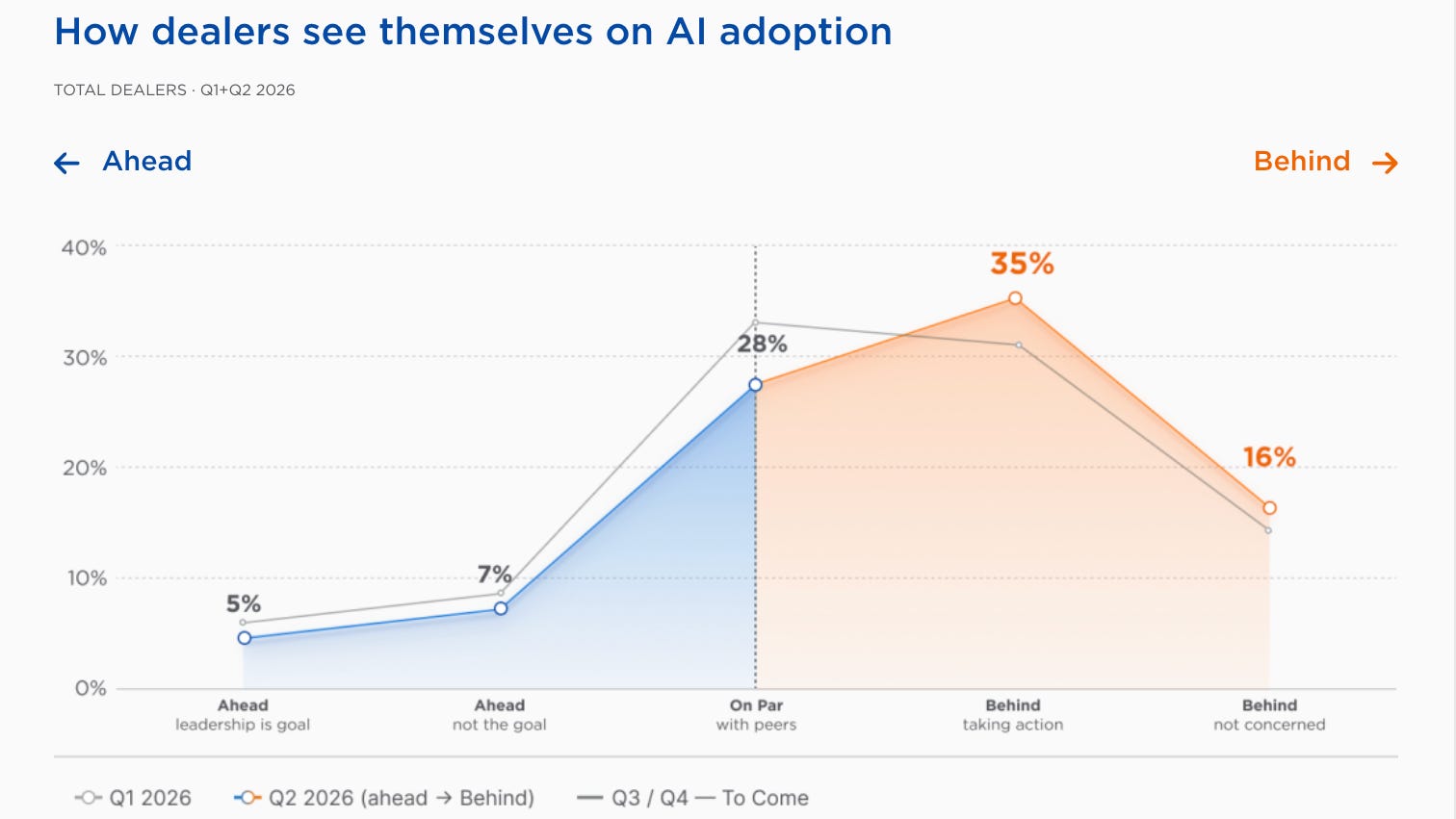
Picture the customer walking into a dealership with three models, two financing scenarios, a trade-in estimate, and a list of questions assembled with AI. That isn’t a cold lead. It’s a buyer who’s already halfway through the conversation.
Cox Automotive says 24% of shoppers feel AI helps them arrive better prepared. Meanwhile, only 29% of dealers are changing how they show up in AI-powered search. The mismatch continues inside the business: 82% report using AI, 69% expect it to drive sales or revenue, but only 22% of AI-using dealers say they’re seeing that growth. Roughly one in three aren’t measuring the impact or don’t know if it exists.
That’s the practical problem. A prepared buyer can still hit an unprepared journey. The website can’t confirm the exact vehicle. The showroom starts the discovery process again. Pricing changes between the AI answer and the desk. The salesperson has no record of what the customer already compared.
The opportunity isn’t to out-talk the customer’s AI. It’s to continue the work with better evidence, current inventory, clear pricing, and a person who can correct the brief when it gets something wrong.
Bottom Line: If the customer arrives ready and your journey makes them start over, the intelligence was on the wrong side of the desk.
📬 Copy-Paste Take
Customers using AI for research aren’t skipping the buying journey. They’re doing more of it before you can see them. Design the handoff from AI research to your website, salesperson, pricing desk, and follow-up as one conversation. The customer shouldn’t have to rebuild the context at every stop.
🧭 OPERATOR PLAYBOOK
Stop Making the Buyer Start Over
Choose one high-consideration journey where customers now arrive with recommendations, comparisons, or questions from an AI assistant.
Audit it for four things:
Recognition: Can the customer bring the shortlist, prompt, quote, or assumptions into your journey?
Verification: Can your team confirm inventory, price, policy, eligibility, and timing without guesswork?
Correction: When the AI got something wrong, can someone explain and fix it without dismissing the customer?
Continuity: Does the context move from digital research to the person who owns the next step?
Then test the handoff with a real scenario. Start in an AI assistant, move to your website, call the business, and show up in person. Count how many times the customer has to restate the same need.
Ask your team: If a customer arrives with an AI-built brief tomorrow, can we continue the conversation or only restart it?
Signal: AI-prepared customers raise the value of continuity, evidence, and human judgment.
📊 MARKET REALITY CHECK
The AI Answer Is Not the Last Word
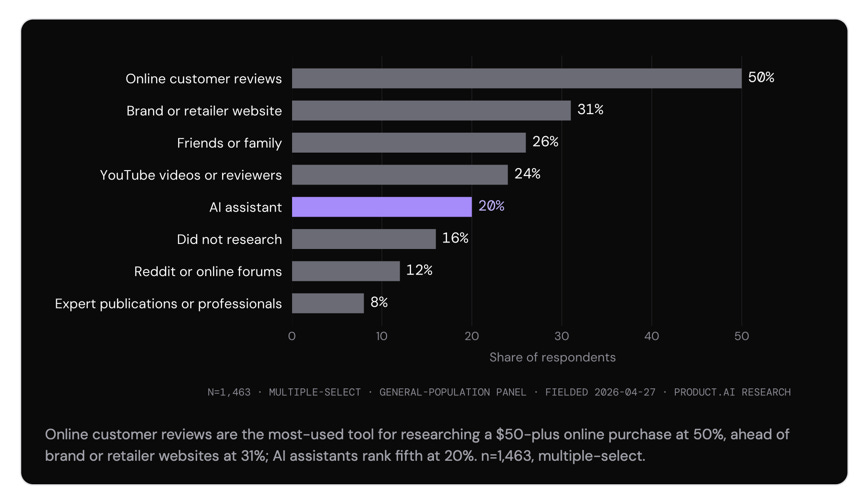
86% of the shoppers who had recently used AI for product research said they checked its recommendation against another source before buying. Forty-five percent always verified it. Another 41% sometimes did. Only 14% trusted the recommendation without checking.
Product.ai surveyed 1,463 U.S. online shoppers, including 623 recent AI-shopping users. The study did not determine which source each person used to verify the answer. But the behavior is clear: the AI recommendation usually creates another step before the purchase.
That step is now part of the customer journey. The brand site, reviews, current inventory, pricing, and salesperson may all be asked to confirm what the AI said. When they disagree, the customer has to decide which source deserves trust.
Why it matters: Customers do not need another generic answer. They need an easy way to verify the recommendation and resolve a mismatch without rebuilding the research.
AI recommendation + easy verification = confidence that can convert.
🧰 TOOL WORTH KNOWING
Vyro Chat
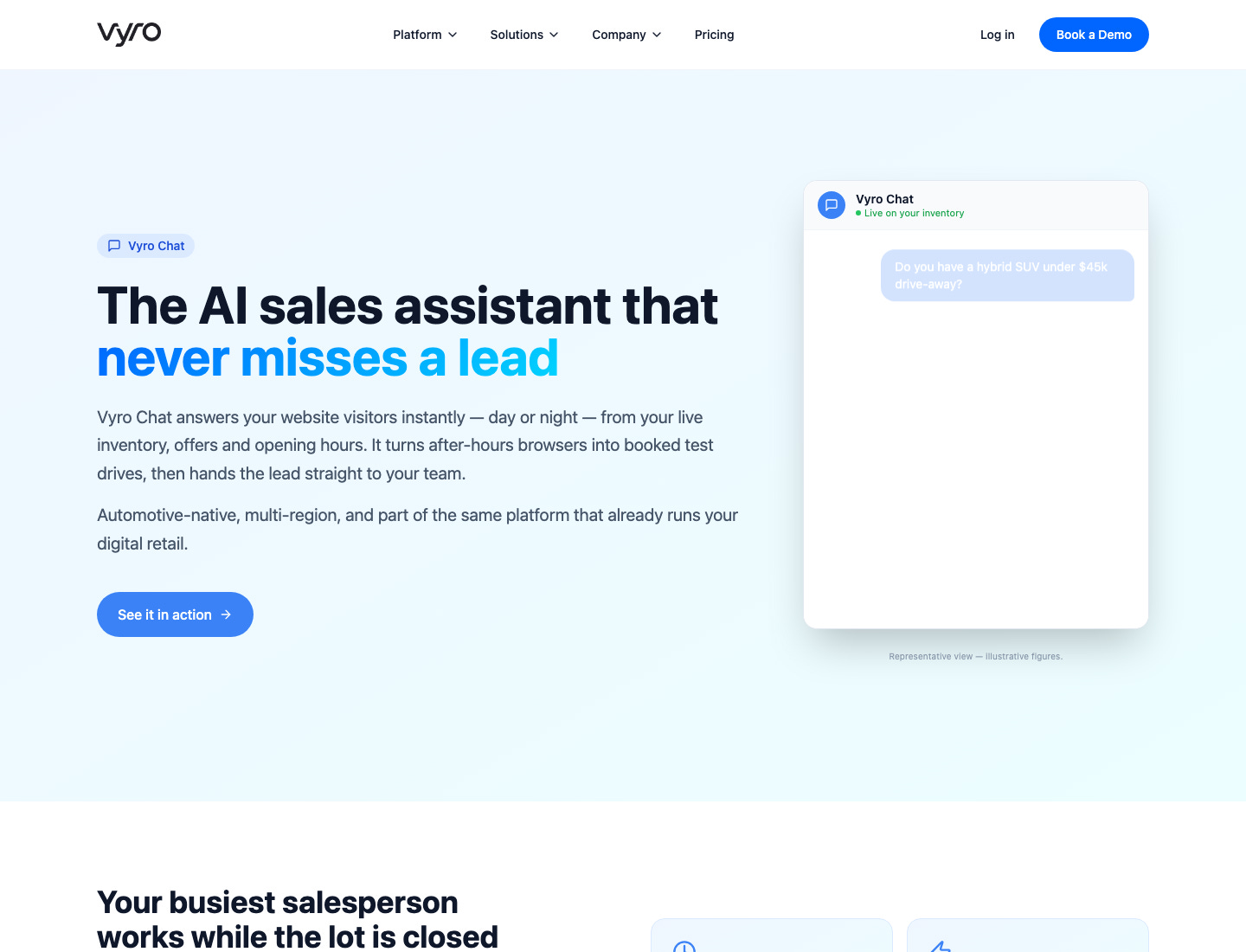
What it does: Vyro Chat is an automotive AI sales assistant grounded in a dealer’s live inventory, current offers, locations, and opening hours. It can answer product questions, surface matching vehicles, and route customers into existing test-drive, finance, service, or contact forms.
CX use case: A customer asks for a seven-seat hybrid under a specific drive-away price after the showroom closes. Vyro Chat searches live stock, answers against the dealer’s data, and carries the intent into the next action instead of leaving another unqualified form in the morning queue.
Worth watching because: The dealer controls response rules, handoff triggers, allowed tools, and domain-scoped web search. Conversations and outcomes remain visible, which gives the team something more useful to manage than a raw chat count.
Bottom line: The useful AI assistant isn’t the one with the smoothest answer. It’s the one that connects the answer to current inventory, a real next step, and a team that can see what happened.
The DCX AI Today - AI Tool Directory - If you lead a CX team and want a curated shortlist of tools worth evaluating, this is your starting point.
📡 90-SECOND CX RADAR
Five AI engines, five different Goldmans
5W tested more than 60 prompts across five AI engines. The answers produced different versions of Goldman Sachs, from historical scandal to current financial performance.
Why it matters: Your AI-era reputation depends partly on which assistant the customer asks and which sources that assistant trusts. Audit the answers, not just your search ranking.
AI can amplify the cracks in your customer journey
Five9’s chief product officer argues that adding AI to disconnected data and systems can leave customers repeating themselves while agents still lack context. This is vendor commentary, not independent research, but the operating test is sound.
Why it matters: Before adding another AI feature, check whether identity, history, ownership, and the next action survive the handoff.
✅ YOUR MOVE
Test the Journey From the Customer’s Side
Customers are using AI to arrive better prepared. That makes a disconnected buying journey easier to spot, not easier to excuse.
And the human conversation still matters when the decision is expensive, unfamiliar, or hard to reverse.
Before Friday, run one journey from the customer’s side. Build a shortlist with an AI assistant, enter your digital experience, contact the team, and try to complete the next step.
Track what survives the handoff: the customer’s need, the comparison, the price, the evidence, and the owner.
When the customer arrives with context, don’t reward the effort by asking them to start again.
Until tomorrow,

👥 Share This Issue
Think of one person who’s wrestling with AI in CX right now
and forward this to them.
I’m obsessed with Wispr Flow Pro! Get a Free Month on me.
If someone forwarded this to you, they thought you needed to see it before your next AI planning meeting. Get your own copy.